Lactic Acid for Acne Scars and Post-Acne Marks: What It Can and Can't Fix
Waleed
30 Sep 2026
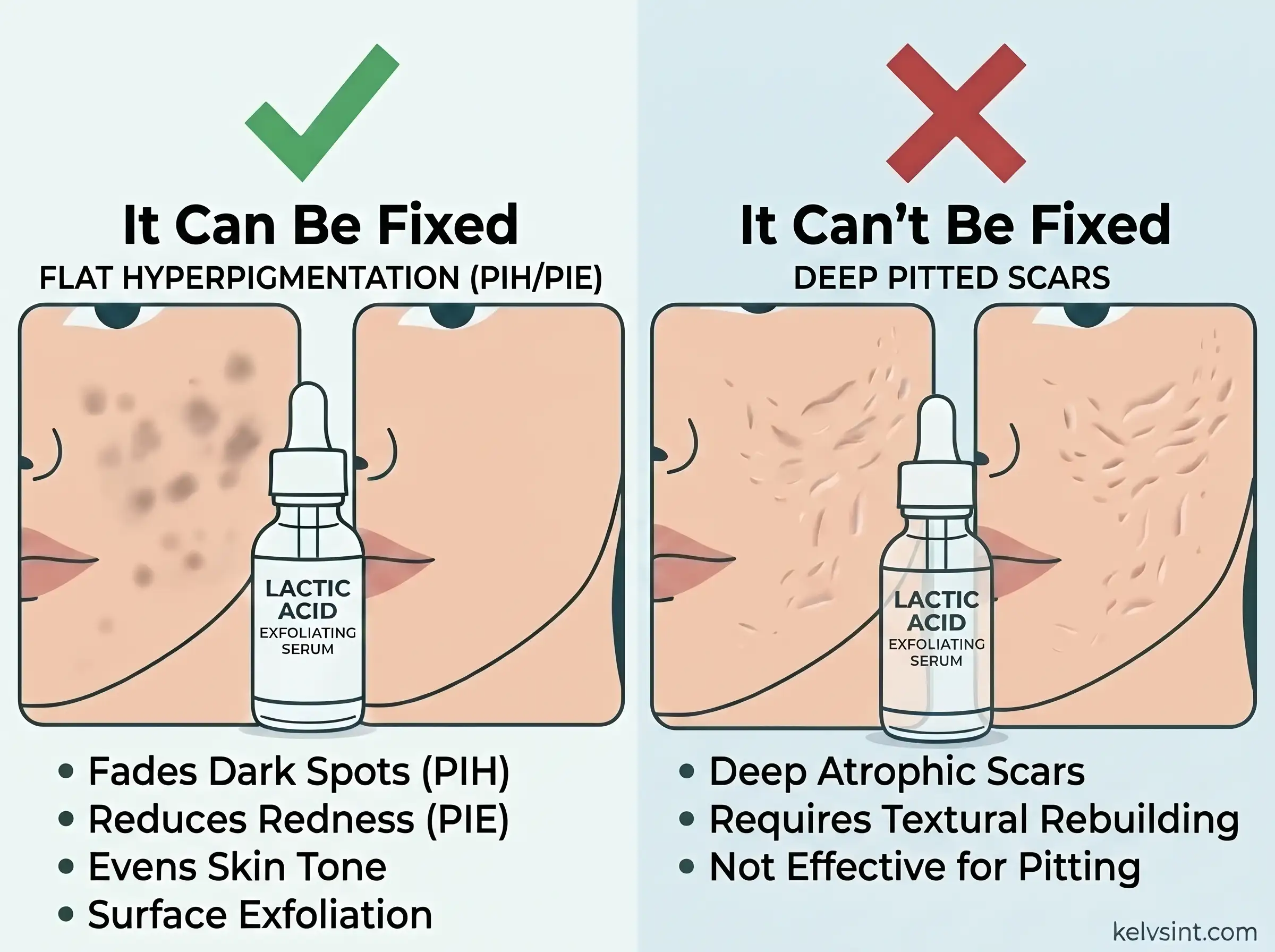
Acne scars and acne marks get used interchangeably, but they are two very different things and lactic acid's ability to help with each is not the same. This guide separates flat pigmentation from true textural scarring and sets realistic expectations.
Introduction
"Acne scars" is one of those phrases people use to describe two genuinely different things: the flat, discoloured marks left behind after a pimple heals, and the actual pitted, textured indentations that some acne leaves in the skin permanently. Lactic acid gets recommended for both — but its ability to help is not remotely the same for each one, and conflating them leads to disappointment either way.
The short answer: lactic acid, at the concentrations found in home skincare, is genuinely useful for fading flat post-acne marks (post-inflammatory hyperpigmentation). For true textural scarring — ice pick, boxcar, or rolling scars — it has some documented benefit, but only at professional peel strength, and even then it's realistically limited to superficial scarring rather than deeper, more established scars. This guide separates the two clearly and explains what to actually expect from each.
Acne Marks vs Acne Scars: The Distinction That Actually Matters
Post-acne marks (clinically, post-inflammatory hyperpigmentation, or PIH) are flat. They're discoloured — often red, brown, or dark depending on skin tone — but if you run your finger over them, the skin surface itself feels no different from the surrounding area. These form because the inflammation from a healing pimple triggers extra melanin production in that spot, and they typically fade on their own over months, faster with the right ingredients and consistent sun protection.
Acne scars are structural. They involve an actual change in the skin's texture — usually a depression, caused by collagen loss during the healing of a deeper, more inflamed lesion. These are generally classified as ice pick (narrow and deep), boxcar (wider with defined edges), or rolling (shallow, sloping edges) scars, and unlike flat marks, they do not fade or resolve on their own over time.
This distinction is the entire reason lactic acid's usefulness differs so much between the two. It works on the surface, primarily by speeding up the shedding of pigmented cells — a mechanism that maps well onto flat discolouration but does very little for a structural indentation in the skin.
Lactic Acid for Post-Acne Marks (PIH)
For flat, discoloured marks, lactic acid has a real and fairly well-understood role, through two separate mechanisms. First, its exfoliating action clears pigmented surface cells faster than normal turnover would, so existing marks fade somewhat sooner. Second, and more specific to lactic acid, research has shown it has a direct, if modest, inhibitory effect on the enzyme responsible for producing melanin in the first place — a mechanism studied directly using lactic and glycolic acid on melanocytes and published in Experimental Dermatology. That study found both acids reduced melanin formation in a dose-dependent way, working on the pigment-producing enzyme itself rather than just removing pigment already sitting on the surface.
This gives lactic acid a genuine, two-part contribution to fading post-acne marks — meaningfully more than "just an exfoliant" — though it's worth being accurate that this effect is more modest than a dedicated brightening ingredient built specifically to block pigment production. For more on that comparison, see Lactic Acid for Hyperpigmentation and Dark Spots: Does It Actually Work?, which covers the mechanism in more depth alongside how it compares to alpha arbutin and niacinamide.
Lactic Acid for True Acne Scars (Textural)
The picture changes considerably once you're talking about actual textural scarring rather than flat marks. There is research specifically on this — a study published in the Journal of Cosmetic Dermatology evaluated full-strength, 92% pure lactic acid peels, applied by a dermatologist every two weeks for up to four sessions, specifically in patients with superficial acne scarring and pigmentation. The result was meaningful improvement — but two details matter enormously here: the concentration used was 92%, applied professionally, nowhere close to what's in any over-the-counter serum, and the scarring being treated was specifically described as superficial.
That second point is the key limitation. Superficial scarring — shallow, minor textural irregularity — responds differently than deeper ice pick or boxcar scars, which involve more significant collagen loss and generally require more intensive intervention: stronger peels like TCA, microneedling, or laser treatments, often in combination, under professional supervision. Lactic acid, even at professional peel strength, is not positioned in the dermatological literature as a solution for deep or established atrophic scarring — it has a role for the mildest end of textural irregularity and works better as one part of a broader in-clinic approach than as a standalone fix.
What This Means for a Home Skincare Routine
Translating that research into a realistic expectation for a cosmetic lactic acid serum used at home:
- Flat post-acne marks: a reasonable and genuinely useful target for a home-use lactic acid serum, especially combined with consistent sun protection and, ideally, a dedicated brightening ingredient alongside it.
- Very mild textural unevenness: some improvement is plausible with consistent long-term use, though nowhere near what a professional-strength peel achieves.
- Genuine ice pick, boxcar, or rolling scars: a home lactic acid serum will not meaningfully change these. This level of scarring is a dermatology conversation, not a skincare-routine one.
Setting the right expectation here matters, because assuming a serum will "fix" structural scarring leads to months of disappointment with a product that was never capable of doing that job in the first place — not because the product is poor, but because the goal was mismatched to the tool.
Preventing New Marks Matters as Much as Fading Old Ones
Since every new inflamed breakout is a chance for a fresh mark — or, in more severe cases, a new scar — to form, managing ongoing acne is arguably as important as treating the marks already there. Lactic acid does have a documented, if modest, preventive role here too. For more on that specific angle, including a long-term clinical study on lactic acid and new lesion formation, see Lactic Acid for Acne: Does It Actually Work?. For managing active acne more directly, Niacinamide for Acne-Prone Skin: Does It Work and How Fast? addresses oil and inflammation through a different mechanism entirely, and pairs well alongside lactic acid rather than replacing it.
Sunscreen Is Not Optional Here
Sun exposure directly worsens post-acne pigmentation, and exfoliating acids including lactic acid increase the skin's sensitivity to UV. Using lactic acid on post-acne marks without daily sunscreen means new pigmentation can form at close to the same rate the acid is fading the old marks — very little net progress, despite consistent product use. This matters year-round given Pakistan's sun exposure levels, not just in summer.
A Note on Whitening Creams and Scarring
It's worth mentioning that some of what looks like stubborn "acne scarring" in Pakistan is actually rebound damage from harsh whitening or steroid-based creams rather than true acne scarring — this presents differently and needs a different approach entirely. If marks or breakouts appeared or worsened after using a whitening cream, it's worth reading How to Repair Your Skin Barrier After Whitening Cream Damage before assuming a standard acid routine is the right fix.
How to Use Lactic Acid for Post-Acne Marks
- Start at two to three times a week in the evening, on clean skin, followed by a moisturiser
- Apply sunscreen every morning without exception
- Give it eight to twelve weeks before assessing results — pigmentation fades gradually, not overnight
- Pair with a dedicated brightening ingredient like alpha arbutin or niacinamide for more targeted fading of stubborn marks, layered in separate steps rather than all at once
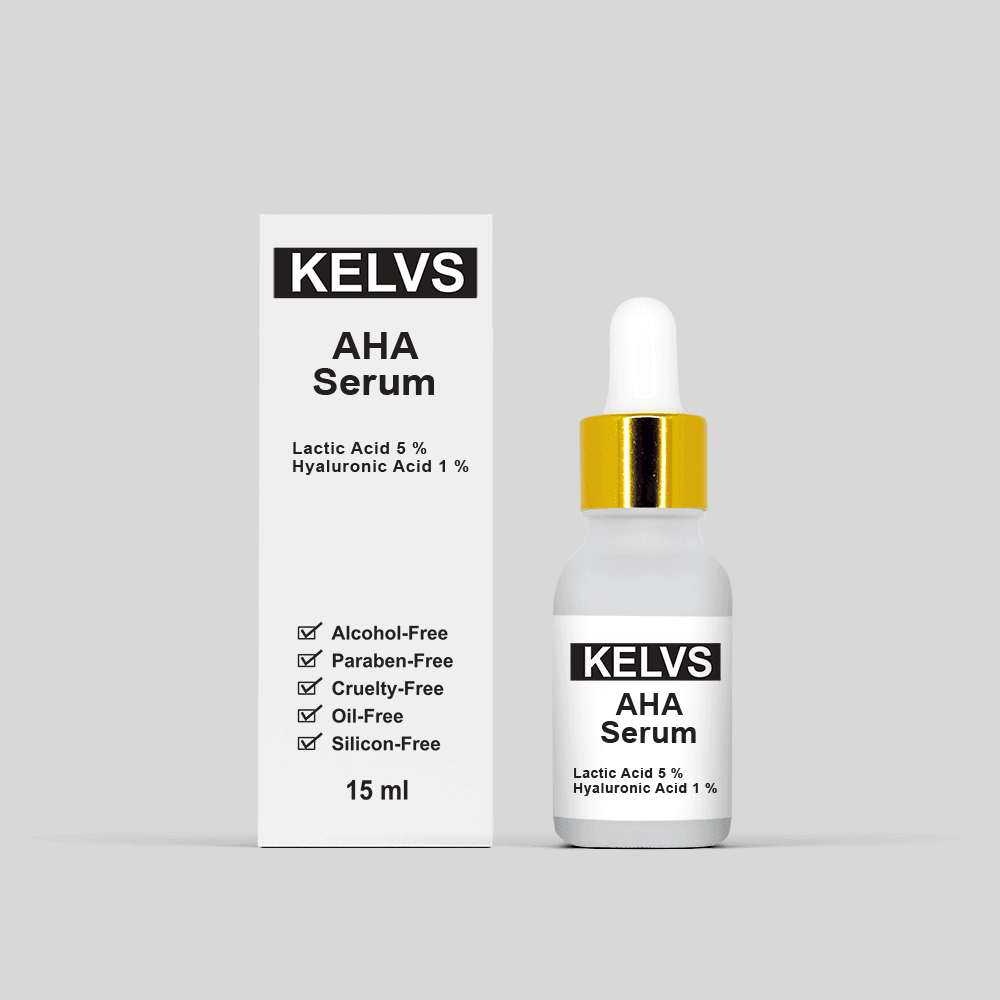
The KELVS AHA Serum, formulated at 5% lactic acid with hyaluronic acid, is built for exactly this kind of consistent, lower-irritation use on marks and surface texture — not positioned or intended as a scar-removal treatment, which is a different category of problem requiring professional-strength intervention.
 Official
KELVS AHA Lactic Acid 5% Serum | Smooth Skin Texture & Even Tone
Scientifically formulated for maximum efficacy with zero harsh irritants. Restores skin balance, clears pores, and accelerates visible recovery.
Conclusion
Lactic acid does two different jobs depending on what you're actually dealing with. For flat, discoloured post-acne marks, it's a genuinely useful ingredient with a real, dual mechanism behind it — exfoliation plus a direct, modest effect on melanin production. For true textural scarring, the honest picture is more limited: even at professional peel strength, the evidence supports it mainly for superficial scarring, not the deeper ice pick or boxcar scars that need dermatological treatment. Knowing which one you're actually looking at in the mirror is the difference between a routine that realistically works and one that was never going to.