Niacinamide for Oily Skin in Pakistan: The Science Behind Pore and Oil Control
Waleed
07 May 2026

Harsh cleansers strip oily skin, causing it to produce *more* grease. **Niacinamide** fixes this by regulating oil at the source—the sebaceous glands. It balances midday shine and protects your barrier gently enough for Pakistan's humid climate.
Introduction
Oily skin is one of the most widely reported skin concerns across Pakistan. Walk into any beauty parlour from Karachi to Peshawar and you will hear the same complaints: skin that looks shiny within an hour of washing, pores that appear permanently enlarged, makeup that melts by midday, and a daily cycle of blotting and re-blotting that never quite resolves the problem. For most people dealing with this, the instinct is to fight the oil — to cleanse more aggressively, use astringent toners, apply alcohol-based products, or layer mattifying formulas until the skin looks controlled.
The problem with this approach is that it worsens the underlying condition. The more the skin is stripped of its natural oils, the more its sebaceous glands compensate by producing more sebum. The more the barrier is disrupted, the more reactive and inflamed the skin becomes — and inflammation drives further oil production. It is a cycle that is familiar to anyone with oily skin in Pakistan, and it is a cycle that conventional oil-fighting approaches consistently fail to break.
Niacinamide approaches oily skin differently. Rather than stripping oil after it is produced, it regulates the sebaceous glands that produce it in the first place — reducing sebum output gradually, supporting the barrier that drives compensatory oiliness, and producing results that do not rebound when the product is discontinued. This guide explains the science behind how it does this, how long it takes, and exactly how to use it in a routine suited to Pakistan's demanding climate.
What Causes Oily Skin?
Oily skin — clinically described as seborrhoea — occurs when sebaceous glands produce more sebum than the skin and hair follicles can manage without visible congestion and shine. Understanding what drives this overproduction is the first step toward addressing it effectively, because different drivers require different approaches.
Genetics and Sebaceous Gland Density
The baseline level of sebum production is largely genetically determined. People with a higher density of sebaceous glands — or glands that are constitutionally more active — will tend toward oily skin regardless of climate or skincare routine. This is the component of oiliness that cannot be fully eliminated, only managed.
Hormonal Fluctuations
Androgens — male sex hormones present in both men and women — stimulate sebaceous gland activity directly. This is why oily skin is particularly common during puberty, during hormonal fluctuations in the menstrual cycle, and during periods of elevated stress, when androgen levels rise. Hormonal acne and oily skin are driven by the same underlying mechanism.
Pakistan's Climate
Pakistan's climate is one of the most significant contributors to oily skin in the country. High ambient temperatures stimulate sebaceous gland activity — sebum becomes less viscous in heat and is produced more readily. High humidity in cities like Karachi, Hyderabad, and coastal areas reduces the rate at which sebum evaporates from the skin surface, causing visible accumulation faster than in drier climates. Across most of Pakistan's urban centres — Lahore, Islamabad, Multan, Faisalabad — the combination of summer heat, humidity, and urban heat island effects creates conditions that drive oiliness to a degree simply not experienced in temperate climates where most skincare products are developed.
Harsh Skincare Routines
This is the most underappreciated driver of persistent oiliness in Pakistan, and it is entirely preventable. Aggressive cleansers, stripping toners, physical scrubs, and multiple-active routines all damage the skin barrier. When the barrier is compromised, it loses moisture — and the skin's sebaceous glands respond to this moisture deficit by increasing sebum production as a compensatory mechanism. This means that the Pakistani skincare habit of using harsh cleansing products to manage oiliness is, for many users, actively worsening the oiliness they are trying to treat.
Over-Cleansing
Washing the face more than twice daily with surfactant cleansers removes not only excess sebum but also the ceramides and protective lipids that form the skin barrier. Each additional wash strips a little more of this protective layer, driving more compensatory oil production. Twice-daily gentle cleansing is the clinical recommendation — frequency beyond this is counterproductive for oily skin.
What Is Niacinamide?
Niacinamide is the active cosmetic form of vitamin B3, a water-soluble vitamin that is involved in skin cell energy metabolism and repair. It works across multiple biological pathways simultaneously — which is why a single ingredient can address oil control, barrier repair, inflammation, and uneven tone at once. Its stability across a wide temperature range, its compatibility with most other skincare ingredients, and its well-documented safety record for long-term daily use make it particularly practical for Pakistani users dealing with the combined pressures of heat, humidity, acne, and pollution.
How Niacinamide Helps Control Oil
The mechanism by which niacinamide controls sebum production is specific and well-documented. Niacinamide inhibits the enzymatic processes that regulate lipid synthesis within sebaceous glands — specifically, it downregulates the activity of the enzymes responsible for producing the lipids that constitute sebum. Over consistent daily use, this produces a measurable reduction in the total volume of sebum secreted per unit time.
This mechanism has been verified in multiple clinical studies. A widely referenced study comparing 2 percent niacinamide to a vehicle control found significant reductions in sebum excretion rate over four weeks of twice-daily topical application. Larger studies at 4 to 5 percent concentration have demonstrated reductions in sebum excretion of up to 30 percent over eight to twelve weeks — a meaningful and visible change in skin oiliness that users report as reduced shine, fewer blotting requirements, and improved makeup wear.
Crucially, niacinamide achieves this without drying the skin. Unlike astringents, alcohol-based toners, or clay masks — which temporarily reduce oil by physically removing it or dehydrating the skin surface — niacinamide reduces the rate at which oil is produced in the first place. This means the reduction is sustained between applications, accumulates over time, and does not produce the compensatory rebound oiliness that follows barrier-stripping approaches.
According to the American Academy of Dermatology, non-comedogenic, non-stripping ingredients that regulate sebum production rather than removing it aggressively are the recommended approach for managing oily skin — a description that precisely characterises niacinamide's mechanism.
Does Niacinamide Actually Reduce Pores?
This is one of the most important myth clarifications in skincare, and niacinamide is frequently at the centre of it. The short answer: niacinamide does not shrink pores. No topical skincare ingredient does. Pore size is a physical characteristic of the skin's anatomy — determined by the diameter of the hair follicle and sebaceous gland opening — and it is fundamentally unchanged by what is applied to the skin surface.
What niacinamide does do — and does measurably — is reduce the appearance of enlarged pores. This is not a trivial distinction, because the visible improvement is real and meaningful, even if the underlying anatomy has not changed. Pores appear larger when they are congested with sebum and dead skin cells that stretch the follicle opening, and when the surrounding skin is dehydrated and lacking elasticity, creating a contrast that makes pore openings more visible. Niacinamide improves pore appearance through two complementary mechanisms:
- Sebum reduction — less sebum in the follicle means less congestion, less stretching of the pore opening, and a smaller apparent diameter
- Barrier support and hydration — niacinamide's ceramide-stimulating action improves skin elasticity and hydration, smoothing the skin surface around pore openings and reducing the visual contrast that makes them appear larger
Most users with significant pore concerns notice a visible improvement in pore appearance between weeks six and ten of consistent twice-daily niacinamide use. This improvement is real but it is not permanent — discontinuing niacinamide allows sebum production and congestion to return to baseline, and pore appearance reverts accordingly. Managing pore appearance with niacinamide is a maintenance practice, not a one-time treatment.
Niacinamide for Acne and Oily Skin
Oily skin and acne are closely connected — but the relationship is more nuanced than simply "more oil causes more acne." Excess sebum is a necessary condition for acne but not a sufficient one. The full acne equation also requires follicular hyperkeratinisation (abnormal cell shedding that blocks the follicle), the presence of Cutibacterium acnes bacteria, and an inflammatory response to bacterial colonisation. Niacinamide addresses three of these four factors simultaneously.
Its sebum-reducing action decreases the oil substrate that feeds C. acnes proliferation. Its anti-inflammatory action reduces the immune response that converts a microcomedone into a visible inflammatory lesion. Its barrier-repairing action restores the microbiome-regulating environment that keeps C. acnes in check. For oily, acne-prone skin — which is among the most common skin type presentations across Pakistan's teenage and young adult population — this multi-mechanism approach produces comprehensive improvement that single-target acne treatments cannot match.
At 4 to 5 percent concentration, niacinamide has been shown in clinical comparisons to deliver acne improvement comparable to topical antibiotic treatments for mild to moderate acne — without the photosensitisation, irritation, or antibiotic resistance concerns associated with antibiotic use.
Why Oily Skin Still Needs Moisture
The most widespread misconception about oily skin in Pakistan is that it does not need moisturiser — that adding any hydrating product will make skin oilier or more prone to breakouts. This belief leads many oily-skin users to skip moisturiser entirely, which is one of the most consequential mistakes in Pakistani skincare routines.
Oily skin and dehydrated skin are not mutually exclusive. The skin can be simultaneously producing excess sebum and lacking adequate water in the stratum corneum — a condition called dehydrated oily skin that is extremely common in Pakistan, particularly in air-conditioned environments, in dry winter months across Punjab and KPK, and in users who have been over-cleansing with stripping products.
When the stratum corneum is dehydrated, the barrier signals the sebaceous glands to produce more oil as a compensatory measure — worsening the very oiliness the user was trying to manage. Applying a lightweight, non-comedogenic moisturiser breaks this cycle by providing the water-phase hydration the stratum corneum needs without adding oil that would further increase sebum load.
For oily skin in Pakistan's summer, a gel-based ceramide moisturiser applied in a thin layer after niacinamide serum provides sufficient hydration without the occlusive weight that heavier creams contribute in high-humidity conditions. In drier winter conditions, a slightly richer ceramide lotion is more appropriate. The key is always non-comedogenic and fragrance-free — not no moisturiser at all.
Best Niacinamide Percentage for Oily Skin
For oily skin management — including sebum reduction, pore appearance improvement, and acne support — 5 percent niacinamide is the optimal concentration for daily independent cosmetic use. This is where the clinical evidence for sebum reduction is strongest, where the tolerance profile is best across all skin types including oily-sensitive presentations, and where the twice-daily routine that produces the most sustained results is most comfortably maintained.
Ten percent niacinamide produces marginally more sebum reduction in some studies, but introduces a flushing risk — temporary redness and warmth from nicotinic acid conversion — that is amplified by Pakistan's heat and that complicates assessment of results on acne-affected skin. For oily skin users experiencing flushing from a 10 percent product, stepping down to 5 percent almost always produces equivalent visible oil control with a significantly more comfortable experience.
Concentrations above 10 percent are not appropriate for oily skin management in independent daily use and offer no established clinical advantage over 5 percent for this purpose.
How to Use Niacinamide for Oily Skin
The routine for oily skin should be deliberately minimal — every additional product layer adds to the oil and congestion load that niacinamide is working to reduce. Four products in the morning and three in the evening is sufficient for most oily skin types, even in Pakistan's demanding climate.
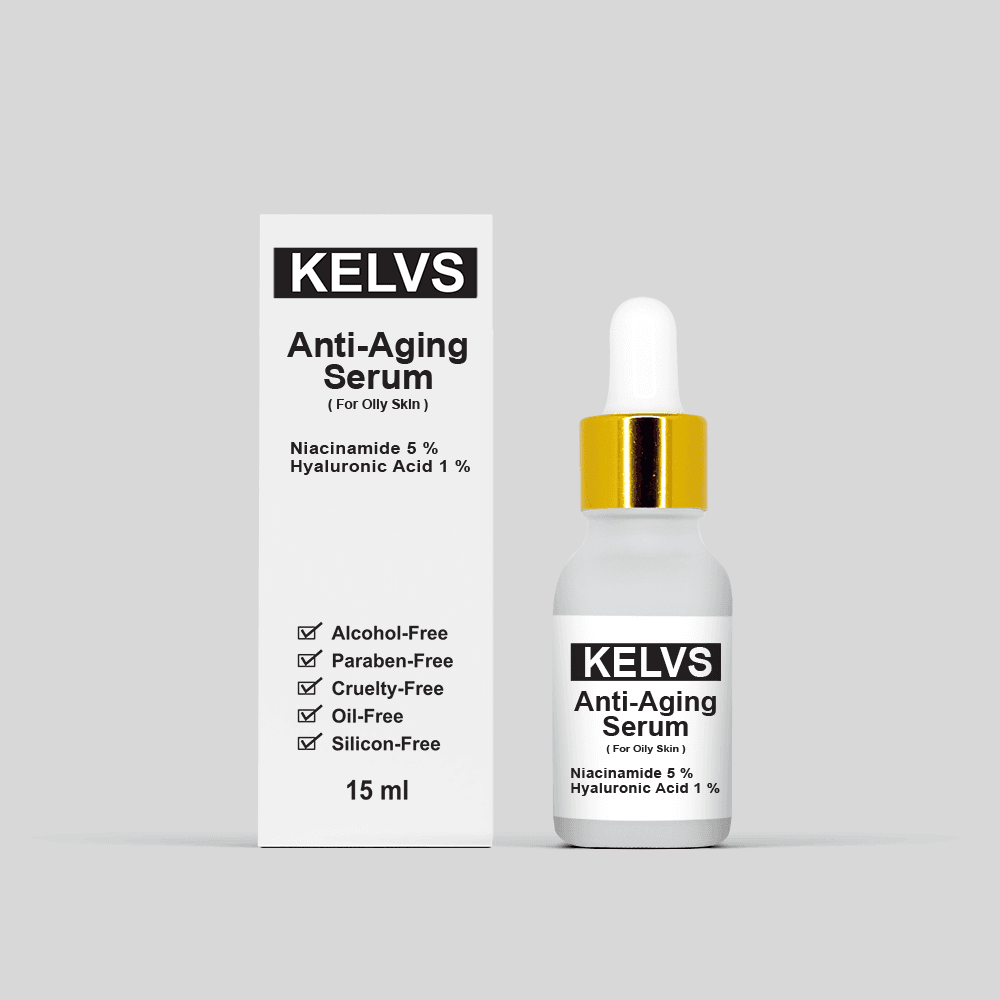
KELVS Niacinamide Serum is formulated in a lightweight, water-based, fragrance-free base specifically designed for oily and acne-prone skin. Its non-comedogenic formulation means it will not contribute to pore congestion, and its quick-absorbing texture does not leave the sticky residue that heavier serums add to already-oily skin. Apply 2 to 3 drops after cleansing, press gently into skin, and allow 60 seconds of absorption before the next step.
Full routine for oily skin incorporating niacinamide:
- Gentle pH-balanced cleanser — sulfate-free, fragrance-free; the cleanser should clean without stripping; if skin feels tight or "squeaky clean" after washing, the cleanser is too harsh and is contributing to compensatory oiliness
- Niacinamide serum — 2 to 3 drops pressed into clean, slightly damp skin; 60 seconds absorption before the next step
- Lightweight, non-comedogenic moisturiser — gel or lotion formula; ceramide-containing if available; non-negotiable even for oily skin
- Mineral sunscreen SPF 30 or above (morning only) — applied as the final morning step; choose a mineral formula labelled oil-free or matte-finish for oily skin in Pakistan's heat; sunscreen without this step means UV continues to drive the inflammation that worsens both oiliness and acne
Morning and Evening Routine for Oily Skin in Pakistan
Morning routine:
- Gentle cleanser — lukewarm water; 60 seconds; pat dry; do not rub
- Niacinamide serum — 2 to 3 drops; press in gently; 60 seconds absorption
- Lightweight gel moisturiser — non-comedogenic, fragrance-free; applied while skin is slightly damp
- Mineral sunscreen SPF 30 or above — oil-free or matte-finish formula preferred; reapply every two hours during outdoor exposure
Evening routine:
- Double cleanse — micellar water or cleansing oil first to remove sunscreen and sebum buildup; then gentle face cleanser; single gentle cleanse if no sunscreen worn
- Niacinamide serum — 2 to 3 drops; 60 seconds absorption
- Lightweight ceramide moisturiser — slightly richer than morning formula if seasonal dryness warrants it; still non-comedogenic
No toner step. No exfoliation step in the daily routine — if chemical exfoliation is part of the routine, use it two to three times per week maximum, as a separate evening step on alternate nights, rather than as a daily addition alongside niacinamide. No facial oil step on oily skin types. Sunscreen is applied only in the morning. The evening routine should take under three minutes from cleanser to moisturiser.
Common Mistakes Oily Skin Users Make
- Over-cleansing — washing the face three or more times daily with surfactant cleansers strips barrier lipids and drives compensatory sebum production; twice daily is the ceiling; hot water worsens this by dissolving protective lipids faster than lukewarm water
- Using harsh physical scrubs — the belief that scrubbing removes blackheads and controls oiliness is one of the most persistent misconceptions in Pakistani skincare; physical scrubs cause micro-tears, barrier disruption, and post-inflammatory pigmentation that worsens all three of the problems they are intended to solve
- Using too many actives simultaneously — loading an oily skin routine with AHAs, BHAs, retinol, vitamin C, and niacinamide simultaneously creates a cumulative active load that inflames the skin and worsens acne; niacinamide works best as the primary active in a simple, focused routine
- Skipping moisturiser — the most consequential mistake for oily skin; no moisturiser means the barrier dehydrates, sebum production compensates, and the oiliness that results is worse than if a lightweight moisturiser had been applied; this is not optional
- Expecting overnight oil reduction — niacinamide's sebum-modulating action accumulates over four to eight weeks of twice-daily consistent use; users who evaluate results at one to two weeks and conclude it is not working abandon the routine before any meaningful biological change has had time to establish
How Long Niacinamide Takes to Control Oil
| Timeframe | What Oily Skin Users Can Expect |
|---|---|
| Weeks 1 to 2 | Skin may feel calmer and less reactive; some users report slightly reduced shine by the end of week two. No significant change in overall oil level yet — sebum regulation requires consistent accumulation over multiple application cycles. |
| Weeks 3 to 4 | Visible reduction in midday shine; blotting paper usage decreases; skin feels less congested in the T-zone and cheeks. Early improvement in pore appearance beginning on the nose and forehead. |
| Weeks 5 to 8 | Meaningful reduction in sebum production; skin maintains a matte appearance for longer after cleansing; pore appearance measurably improved; acne frequency reduces alongside oiliness. This is the primary result window for oil control. |
| Weeks 8 to 12 | Sustained oil control across full day; continued improvement in pore appearance; skin texture significantly smoother. Results are maintained as long as twice-daily application continues and sunscreen is applied every morning. |
Best Routine for Oily Skin in Pakistani Weather
Pakistan's weather creates specific challenges for oily skin management that require practical routine adjustments beyond simply choosing the right serum.
Summer humidity (coastal cities — Karachi, Hyderabad): Use the lightest possible moisturiser — a gel or water-gel formula with no added oils. Apply niacinamide serum first, allow it to fully absorb, then apply a thin layer of gel moisturiser. In extreme humidity, some users can reduce moisturiser to evenings only if morning skin feels comfortable without it — but do not skip it more than two to three days consecutively, as barrier dehydration accumulates. Use a matte-finish mineral sunscreen rather than a heavy SPF cream that adds to the oily feel.
Hot dry conditions (interior cities — Multan, Sukkur, Jacobabad summers): Dry heat dehydrates the stratum corneum rapidly despite the ambient heat. Use a slightly richer gel-cream moisturiser than in humid climates, and apply niacinamide to damp skin immediately after cleansing before the surface moisture evaporates. Indoor air conditioning compounds this dehydration — apply moisturiser proactively rather than waiting until skin feels tight.
Urban pollution (Lahore, Karachi, Peshawar): Particulate matter from urban pollution settles on the skin and increases pore congestion and inflammatory load throughout the day. Thorough but gentle double-cleansing at night — micellar water followed by a gentle face wash — removes both sunscreen and pollution deposit before niacinamide application. This cleansing step is more important in polluted urban environments than in cleaner air contexts.
Sweating during summer outdoor activity: Sweat does not replace moisturiser, and sweat mixed with sebum does not replace skincare steps. After significant sweating, a gentle single cleanse with a pH-balanced cleanser, followed by re-application of the full morning routine including sunscreen, is the correct response — not simply blotting and continuing without cleansing.
Who Should Use Niacinamide for Oily Skin?
- Teenagers with oily and acne-prone skin — niacinamide is one of the safest and most effective first actives for adolescent oily skin; appropriate for daily use, gentle enough for first-time active skincare users, and addresses the sebum-acne cycle without the harshness of conventional acne treatments
- Adults with hormonal or adult-onset oily skin — hormonal fluctuations that drive sebum in adult acne are partially addressed by niacinamide's sebaceous gland inhibition; particularly useful for women experiencing hormonal oiliness during cycle phases or after discontinuing hormonal contraception
- Oily skin users with concurrent sensitivity — oily-sensitive skin — a presentation very common in Pakistan among people who have over-cleansed or used harsh products — responds particularly well to niacinamide because the anti-inflammatory and barrier-repairing actions address the sensitivity component while the oil-regulating action addresses the oiliness
- Anyone with visibly enlarged pores — niacinamide's pore-appearance improvement is among its most consistently noticed benefits; users with pore concerns as a primary complaint find visible improvement within six to ten weeks of consistent use
- Oily skin users building a minimalist routine — niacinamide delivers enough benefit across oil control, barrier support, and tone that many oily skin users can build an effective routine around it as the only active serum, without needing additional targeted treatments
Frequently Asked Questions
Can niacinamide permanently reduce oily skin?
Niacinamide produces sustained sebum reduction during consistent use, but results are maintained by the routine rather than permanently fixed after a treatment period. If niacinamide use is discontinued, sebum production returns to its baseline level over time. For most oily skin users in Pakistan, niacinamide becomes a permanent part of the routine — used twice daily indefinitely — rather than a course of treatment with an endpoint. The results are real and consistent, but they are maintenance results rather than a permanent correction.
Does niacinamide actually shrink pores?
No topical skincare ingredient can physically shrink pores — pore size is an anatomical characteristic that cannot be altered by products applied to the surface. What niacinamide does is reduce the appearance of enlarged pores by reducing the sebum congestion that stretches pore openings and improving the skin texture and elasticity around them. The visual improvement is real and significant — but it is an improvement in appearance rather than a change in the underlying anatomy, and it requires consistent niacinamide use to maintain.
Can I use niacinamide daily for oily skin?
Yes — and twice-daily use is both safe and necessary for producing the sebum-reduction results that oily skin users are seeking. The clinical evidence for niacinamide's oil-control benefits is based on twice-daily application over eight to twelve weeks. Once-daily use produces slower and less consistent results. Niacinamide at 5 percent does not accumulate irritation with daily long-term use, does not cause photosensitisation, and does not require periodic breaks. Daily consistency is the single most important factor in achieving and maintaining oily skin improvement.
Which percentage of niacinamide is best for oily skin?
Five percent is the optimal concentration for oily skin in Pakistan's climate. It delivers effective sebum reduction with the best tolerance profile across all oily skin presentations, including oily-sensitive types. Ten percent produces marginal additional sebum reduction in some users but introduces a flushing risk that is amplified by Pakistan's ambient heat and that can complicate assessment of results on acne-affected skin. The twice-daily consistency that produces the best oil-control outcomes is more reliably maintained at a concentration that does not cause discomfort.
Can oily skin skip moisturiser when using niacinamide?
No. Oily skin and dehydrated skin frequently coexist — particularly in Pakistan, where harsh cleansing habits and air conditioning deplete stratum corneum moisture despite ambient humidity or heat. Skipping moisturiser dehydrates the barrier, which signals the sebaceous glands to produce more compensatory oil, worsening the oiliness niacinamide is working to reduce. A lightweight, non-comedogenic, gel-based moisturiser applied in a thin layer after niacinamide is the correct approach — it will not make oily skin oilier when the right formula is chosen.
Is niacinamide suitable for oily skin in Pakistan's humid weather?
Yes — niacinamide is one of the most climate-practical actives available for Pakistani oily skin users. It is water-based and lightweight, does not require occlusive application, is thermally stable in Pakistan's summer temperatures without special storage, and does not cause photosensitisation in a high-UV environment. In high-humidity conditions specifically, its oil-control action is more valuable rather than less — reducing the sebum that accumulates more visibly in humid conditions. Pair with an oil-free matte mineral sunscreen and a gel moisturiser for a complete, climate-appropriate morning routine.
Conclusion
Oily skin in Pakistan is not simply a cosmetic inconvenience — it is a skin condition driven by climate, genetics, hormones, and often worsened by the very routines intended to manage it. Niacinamide addresses it at the source: regulating sebaceous gland activity, supporting the barrier that drives compensatory oiliness, and reducing the inflammation that compounds acne and congestion. It does all of this without drying, stripping, or sensitising the skin it is treating.
According to DermNet's clinical review of niacinamide, it remains one of the most broadly applicable and well-tolerated topical ingredients for sebum regulation and barrier support in dermatological practice — properties that translate directly to the oily skin challenge faced by a very large proportion of Pakistani skincare users.
The routine is simple. The commitment is twice daily. The results require eight to twelve weeks of consistency and non-negotiable morning sunscreen. For oily skin in Pakistan's heat, humidity, and pollution, this is the most practical, evidence-backed approach available without a prescription — and for most users, it is enough.
 Official
KELVS Anti Aging Serum | Minimizes Pores & Controls Oil
Scientifically formulated for maximum efficacy with zero harsh irritants. Restores skin balance, clears pores, and accelerates visible recovery.