Niacinamide Concentration Guide: 5%, 10% or Higher — Which Is Right for You? (Pakistan Guide)
Waleed
03 May 2026
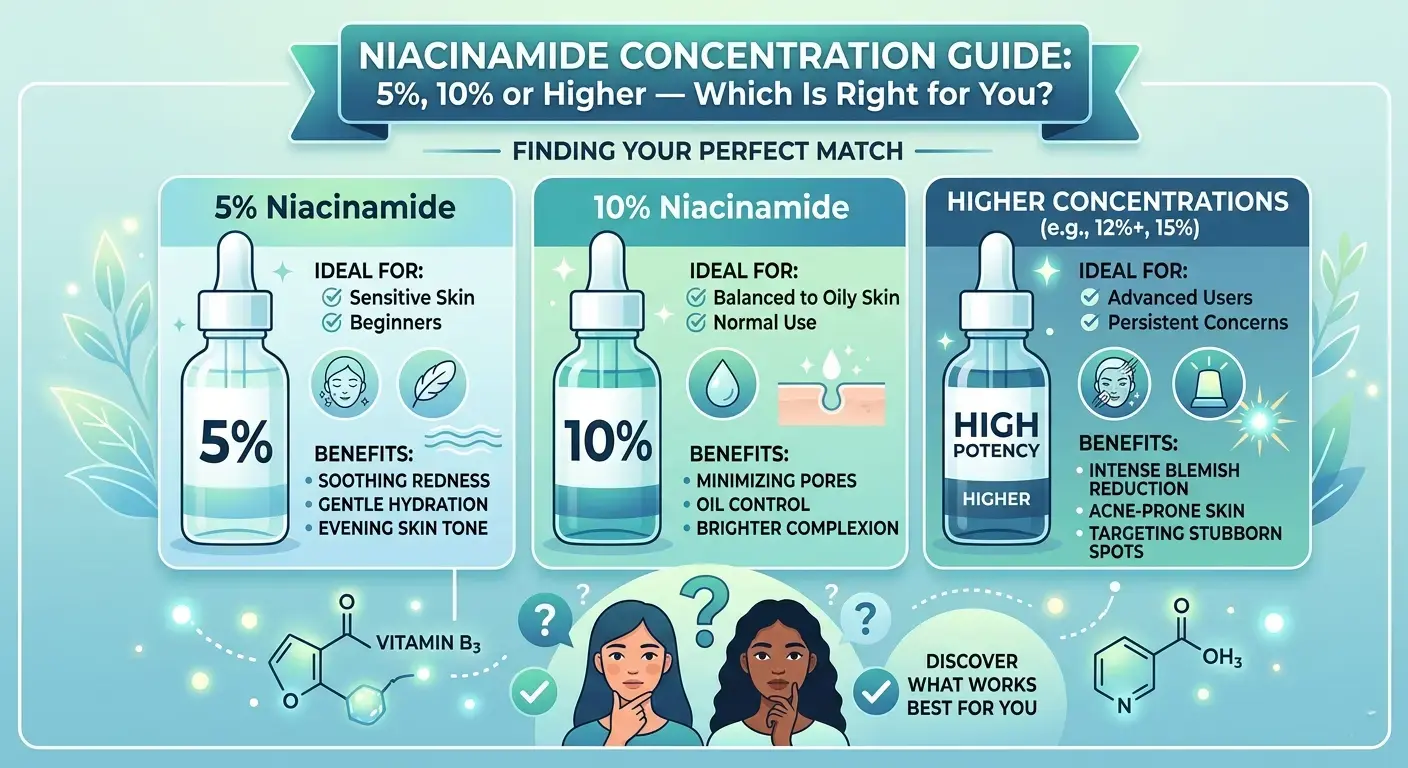
Stronger isn't better. While brands push 10%, clinical data shows **5% Niacinamide** is the sweet spot to regulate oil, heal acne, and repair barriers without irritation. Higher percentages risk redness in Pakistan's heat without adding extra benefits.
Introduction
Walk into any pharmacy or browse any skincare page in Pakistan today and you will find niacinamide serums ranging from 5 percent to 10 percent to 20 percent and beyond — each positioned as if the higher number is simply the better choice. The marketing logic is familiar: more active ingredient, more results. In skincare, this logic fails more often than it holds, and with niacinamide, it fails in a very specific and well-documented way.
Niacinamide is one of the most studied cosmetic actives in dermatology. The clinical evidence for its benefits — oil control, barrier repair, acne improvement, redness reduction, pore appearance — is strong and consistently replicated. But that evidence is concentrated in a specific concentration range. Above it, the benefits plateau while the risks increase. Below it, results are slower but safe. Understanding this relationship between percentage, efficacy, and safety is the difference between a routine that works and one that causes the problems it was meant to solve.
This guide explains what niacinamide concentration actually means, what each percentage range delivers, and which strength is appropriate for your skin type and concern in Pakistan's climate.
What Does Niacinamide Concentration Mean?
Niacinamide concentration — expressed as a percentage — refers to how much active niacinamide is present by weight in the total formula. A 5 percent niacinamide serum contains 5 grams of niacinamide per 100 grams of total product. A 10 percent serum contains 10 grams per 100 grams, and so on.
This percentage is meaningful but it is not the only factor that determines how well a niacinamide product performs. Formulation quality — the supporting ingredients, the pH of the formula, the texture and delivery vehicle — significantly affects how much of the active ingredient actually reaches the skin at a level where it can produce a biological effect. A 5 percent niacinamide serum with a well-designed, compatible base that optimises skin penetration will outperform a 10 percent niacinamide in an unstable or poorly buffered formula every time.
This means that when comparing niacinamide products, percentage is one variable among several — not the only one, and not always the most important one. A product with a clear, disclosed concentration, a simple compatible ingredient list, and a stable formulation base is a more reliable choice than a higher-percentage product that lists niacinamide alongside a dozen incompatible actives in an unstable carrier.
Common Niacinamide Concentrations in Skincare
5% Niacinamide
Five percent is the most extensively studied cosmetic concentration of niacinamide, and it is where the evidence for oil control, barrier repair, acne improvement, pore appearance, and tone-evening is strongest. The majority of the clinical trials that established niacinamide's benefits used concentrations between 4 and 5 percent. For most skin types and most skin concerns, 5 percent provides effective tyrosinase inhibition, sebum modulation, and ceramide stimulation without the flushing risk that increases at higher concentrations. It is the standard, the benchmark, and the concentration dermatologists most consistently recommend for independent daily cosmetic use.
10% Niacinamide
Ten percent niacinamide is a high cosmetic concentration. Some users with healthy, non-sensitive skin find it well-tolerated, and there is some evidence that higher concentrations may produce marginally faster sebum reduction. However, at 10 percent, niacinamide begins to convert more readily to nicotinic acid in the skin — a process that causes temporary flushing (redness and warmth) in a meaningful proportion of users. This flushing is not dangerous, but on already-reactive, acne-prone, or barrier-damaged skin, it is unwelcome and can be confused with irritation or an allergic reaction, leading to unnecessary discontinuation.
15% and Higher
Concentrations of 15 percent and above are primarily found in products marketed aggressively on the basis of percentage strength. At these levels, the incremental benefit over 10 percent is not clinically established for most skin concerns, while the flushing risk and potential for sensitivity reactions increases further. For the vast majority of users — including those with significant acne, oiliness, or barrier concerns — these concentrations offer no meaningful advantage over 5 percent and carry a higher risk of the skin reactions that disrupt the consistent routine upon which all of niacinamide's results depend.
Niacinamide 5% vs 10% vs Higher — Key Differences
| Consideration | 5% Niacinamide | 10% Niacinamide | 15%+ Niacinamide |
|---|---|---|---|
| Effectiveness | Well-established — clinical evidence concentrated at this range | Marginally stronger on sebum; similar overall benefit to 5% for most users | No established clinical advantage over 10%; incremental benefit unproven |
| Irritation Risk | Low — well-tolerated across all skin types | Moderate — flushing occurs in a meaningful proportion of users | Higher — flushing and sensitisation risk increases further |
| Daily-Use Suitability | Yes — appropriate for indefinite twice-daily use | Caution — daily use tolerated by many but not all; patch test first | Not recommended for routine daily use on most skin types |
| Acne Suitability | Excellent — addresses sebum, inflammation, and barrier simultaneously | Good — effective but flushing can mimic acne irritation, complicating assessment | Poor for active acne — reaction risk on inflamed skin outweighs benefit |
| Sensitive Skin Compatibility | High — safe including on barrier-compromised and reactive skin | Moderate — patch test essential; may not suit recently sensitised skin | Low — not appropriate for sensitive or barrier-damaged skin |
| Summer Suitability in Pakistan | High — lightweight, no photosensitisation, heat-stable | Moderate — flushing in heat more likely and more pronounced | Low — heat amplifies flushing; high UV environment adds skin stress |
Is Higher Percentage More Effective?
Not in any clinically meaningful way for most users — and this is the most important point this guide can make.
Niacinamide's biological mechanisms follow a saturation curve. At 5 percent, ceramide stimulation, sebum modulation, and melanin transfer inhibition are all operating at a level where clinical results are consistently documented. Between 5 and 10 percent, some studies suggest modest additional sebum reduction. Above 10 percent, the clinical evidence for incremental benefit essentially plateaus — but the incidence of flushing and sensitivity reactions continues to rise.
The practical consequence is straightforward: a user who applies a well-formulated 5 percent niacinamide serum twice daily for twelve weeks with consistent sunscreen will reliably outperform a user who applies a 10 or 15 percent serum sporadically, without sunscreen, in a routine full of incompatible actives that collectively irritate the skin and lead to discontinuation. Concentration is one variable. Consistency, formulation quality, and complementary routine support are the others — and they matter more.
According to the American Academy of Dermatology, effective skincare for oily and acne-prone skin prioritises consistency with well-tolerated, evidence-backed ingredients over escalating to stronger formulations that increase discontinuation risk.
Best Niacinamide Percentage for Different Skin Types
Oily Skin
For oily skin — particularly the persistently shiny, congested oiliness common in Pakistan's humid climate — 5 percent niacinamide is the optimal daily-use concentration. The clinical evidence for sebum reduction is well-established at this level, and the twice-daily use that produces the most sustained results is more reliably maintained when the product does not cause flushing or discomfort. Oily skin in Pakistan's heat also does not benefit from the additional skin stress that higher-concentration niacinamide introduces — the goal is calmer, less oily skin, not more reactive skin with temporarily reduced sebum.
Acne-Prone Skin
For acne-prone skin, 5 percent niacinamide is both sufficient and safer than higher concentrations. Skin with active acne is already in an inflammatory state — introducing a 10 or 15 percent niacinamide product that causes flushing on already-inflamed skin risks worsening the presentation rather than improving it. At 5 percent, niacinamide addresses the four core acne drivers — sebum, inflammation, barrier compromise, and post-acne pigmentation — without adding skin stress. For moderate acne that has not responded to 5 percent after twelve weeks of consistent use, a dermatologist consultation is more appropriate than escalating to a higher niacinamide concentration.
Sensitive Skin
For sensitive, reactive, or barrier-compromised skin, begin at 2 to 3 percent and step up to 5 percent after two to four weeks of confirmed tolerance. The anti-inflammatory and barrier-repairing benefits of niacinamide are genuinely valuable for sensitive skin — but introducing them at 10 percent to a skin type that is already prone to reactive episodes significantly increases the risk of a flushing reaction that may be indistinguishable from a sensitivity reaction, leading to unnecessary discontinuation of a beneficial ingredient. Low and slow is the correct strategy for sensitive skin with any cosmetic active, niacinamide included.
Barrier-Damaged Skin
For skin recovering from barrier damage — whether from steroid cream use, over-exfoliation, or formula cream withdrawal — 5 percent niacinamide introduced after four to six weeks of a minimal repair routine is the appropriate approach. The ceramide-stimulating action of niacinamide is directly therapeutic for barrier repair, but it works best when introduced to skin that has been somewhat stabilised rather than to skin in acute reactive distress. Higher concentrations add unnecessary stress to skin that is already compromised.
Which Niacinamide Percentage Is Best for Acne?
The answer depends on acne severity, but the conclusion is the same across most presentations: 5 percent is the appropriate starting point, and the ceiling for independent daily use in most cases.
For mild to moderate inflammatory acne — the most common presentation in Pakistan, driven by sebum excess, heat, humidity, and dietary factors — 5 percent niacinamide addresses the sebum component, the inflammatory component, and the barrier component that make this type of acne persistent. Clinical studies comparing 5 percent niacinamide to topical antibiotic treatments for mild to moderate acne have documented comparable outcomes, which is a strong statement about the efficacy available at this concentration.
For moderate to severe acne, or for acne that is unresponsive to a consistent 5 percent routine over twelve weeks, the next step is a dermatologist consultation — not escalation to 10 percent niacinamide. Severe acne requires a multi-modality approach that may include prescription topicals or oral medications, and adding a higher niacinamide concentration to a routine that has not responded to 5 percent is unlikely to produce the improvement that professional management would.
Which Percentage Is Best for Sensitive Skin?
For sensitive skin, the priority is establishing tolerance before optimising concentration. Begin with 2 to 3 percent niacinamide and apply it once daily for the first week. If no redness, stinging, or flushing occurs, move to twice-daily application. After two to four weeks of confirmed twice-daily tolerance, step up to 5 percent and repeat the same process. This gradual introduction allows the skin to adapt to niacinamide's barrier-stimulating action without the reactive episode that can occur when a sensitised skin type meets a full therapeutic dose immediately.
Ten percent or above is not appropriate for sensitive skin in independent daily use. The flushing risk at 10 percent is significant for non-sensitive skin; for skin that is already reactive, the likelihood of a reaction that delays or ends the routine is too high to justify the marginal potential benefit over 5 percent.
According to DermNet's clinical review of niacinamide, gradual introduction at lower concentrations followed by step-up to therapeutic levels is the recommended approach for patients with sensitive or reactive skin types — reducing discontinuation rates and allowing the barrier repair benefits of the ingredient to accumulate before the skin is challenged with a full dose.
How to Choose the Right Niacinamide Serum
Concentration is a starting point for evaluation, not the final criterion. A well-chosen niacinamide serum meets the following standards regardless of percentage:
- Disclosed concentration — the percentage is clearly stated on the packaging or product listing; products that do not disclose their niacinamide percentage may contain sub-effective amounts or use niacinamide as a label claim rather than a meaningful active
- Simple, compatible ingredient list — the most effective niacinamide serums pair the active with complementary, non-competing ingredients: hyaluronic acid for hydration, panthenol for soothing, and ceramides or glycerin for barrier support; a long list of additional high-potency actives alongside niacinamide increases cumulative irritation risk and makes attribution of any reaction more difficult
- Absence of synthetic fragrance — fragrance is the most common contact allergen in skincare and has no functional role in a niacinamide serum; its presence indicates a formulation priority that does not favour skin health
- Stable packaging — opaque or airless dispensing preserves the formula against light and air degradation, particularly important in Pakistan's summer temperatures
- pH compatibility with routine — niacinamide performs across a wide pH range, but products formulated at extreme pH values to accommodate co-actives may create mild flushing; simple, neutral-pH niacinamide serums integrate most cleanly into existing routines
KELVS Niacinamide Serum is formulated at an effective concentration with a transparent ingredient list, no synthetic fragrance, and a lightweight water-based texture suited to Pakistan's climate — designed for twice-daily use across oily, acne-prone, and sensitive skin types without the unnecessary complexity that increases reaction risk.
How to Use Niacinamide Based on Concentration
Using a 5% Niacinamide Serum
Apply 2 to 3 drops to clean, pat-dried skin morning and evening. Press gently into the skin — do not rub. Allow 60 seconds for absorption before applying moisturiser. A 5 percent niacinamide serum is appropriate for twice-daily use from the first application for most skin types, including sensitive skin that has been patch-tested without reaction. Pair with a ceramide moisturiser and mineral sunscreen in the morning.
Using a 10% Niacinamide Serum
Introduce at once-daily evening use for the first two weeks. Apply 2 drops to clean skin; allow full absorption before moisturiser. Monitor for flushing — a warm, red sensation that appears within minutes of application and resolves within 20 to 30 minutes. If flushing is mild and resolves quickly, it is a tolerable response. If it is persistent, intense, or accompanied by stinging, step down to 5 percent. After two weeks of confirmed once-daily tolerance, move to twice-daily use if skin remains comfortable. Never apply 10 percent niacinamide over other actives without an absorption interval — the combined irritation potential is higher than either alone.
Adjustment Tips for Either Concentration
- If flushing or redness occurs at your chosen concentration, step down — do not push through persistent irritation
- If results plateau after twelve weeks at 5 percent and the concern is significant, consult a dermatologist before escalating concentration
- Adding sunscreen to the morning routine is not optional — UV exposure re-triggers the inflammation and sebum pathways that niacinamide is working to reduce; without SPF, progress is continuously counteracted
How Long Niacinamide Takes to Work
| Timeframe | Expected Progress | Key Note |
|---|---|---|
| Weeks 1 to 2 | Skin feels calmer; early redness reduction; oily skin may begin to feel less slick by end of week two | Anti-inflammatory effect establishes fastest; sebum and barrier changes are still accumulating beneath the surface |
| Weeks 3 to 4 | Visible reduction in shine; fewer breakouts forming; early improvement in skin texture; pores beginning to appear less congested | Sebum modulation accumulating; ceramide synthesis improving moisture retention |
| Weeks 5 to 8 | Clear improvement in pore appearance; measurable acne reduction; skin significantly smoother; post-acne marks beginning to lighten | Primary result window; multiple sebum and cell turnover cycles producing compounding visible improvement |
| Weeks 8 to 12 | Sustained oil control; barrier integrity noticeably improved; post-acne pigmentation substantially faded; skin handles stress with less reactivity | All mechanisms mature; results represent genuine biological change rather than temporary surface suppression |
Results at any concentration are primarily determined by consistency — twice daily, every day — and by daily sunscreen use. A 5 percent serum applied consistently with SPF will produce better results than a 10 percent serum applied sporadically without UV protection.
Common Mistakes When Choosing Niacinamide Strength
- Choosing the highest available percentage automatically — the most common and most consequential mistake; 10 or 15 percent does not produce proportionally better results for most skin concerns and introduces a flushing risk that frequently disrupts the consistent routine upon which all results depend
- Buying a product without a disclosed concentration — if a product does not state its niacinamide percentage, the concentration is often too low to be effective; always verify the percentage before purchasing
- Over-layering additional actives at the same concentration step — applying 10 percent niacinamide alongside vitamin C, multiple AHAs, and alpha arbutin in the same routine step multiplies cumulative irritation risk; keep the routine simple when introducing a higher-concentration niacinamide
- Skipping sunscreen — without daily mineral SPF 30 or above, UV exposure continuously re-triggers the sebum overproduction and inflammation that niacinamide is working to reduce; this applies at every concentration and is the single most impactful variable in the results timeline
- Expecting results in under four weeks and concluding it does not work — niacinamide's sebum and barrier changes require four to eight weeks of consistent daily use to become visible; two-week evaluations lead to unnecessary discontinuation of an ingredient that was on track to deliver results
Best Choice for Pakistani Skin Types and Climate
For the specific conditions of Pakistan's skincare environment, the recommendation is consistent and clear: 5 percent niacinamide in a well-formulated, fragrance-free, lightweight serum is the optimal choice for the large majority of Pakistani users.
Pakistan's high heat and humidity amplify the flushing that 10 percent niacinamide can cause — flushing in high ambient temperature is more pronounced and more prolonged than in temperate climates. This makes the already-moderate irritation risk of 10 percent more significant in Pakistan's climate, particularly during summer months when ambient temperatures in cities like Karachi, Multan, and Lahore regularly exceed 38 to 45°C.
For the large population of Pakistani skincare users whose skin has been sensitised or compromised by formula cream or steroid cream use, 5 percent — or even 2 to 3 percent as an introduction — is the appropriate starting point, with higher concentrations considered only once full skin stability has been established over several months.
Pakistan's high acne prevalence driven by heat, oiliness, dietary factors, and stress makes niacinamide a particularly high-value ingredient in this market — but maximum benefit is obtained through the concentration and formulation that can be used consistently, not through the highest percentage that markets most aggressively.
Frequently Asked Questions
Is 5% niacinamide enough for pigmentation and oil control?
Yes. Five percent niacinamide is where the clinical evidence for oil control, barrier repair, acne improvement, and melanin transfer inhibition (tone-evening) is most concentrated. For the large majority of these concerns in independent daily cosmetic use, 5 percent delivers effective and well-tolerated results over consistent use. Users who have not achieved sufficient results after twelve weeks of twice-daily 5 percent niacinamide with consistent sunscreen should consult a dermatologist rather than escalating concentration.
Is 10% niacinamide too strong?
For some skin types, yes. Ten percent niacinamide causes transient flushing — temporary redness and warmth — in a meaningful proportion of users due to nicotinic acid conversion at higher concentrations. For sensitive, barrier-damaged, or acne-inflamed skin, this flushing risk is significant and poorly matched to the skin's current condition. For healthy, non-sensitive skin with confirmed tolerance, 10 percent may be appropriate and well-tolerated. The key is patch testing and gradual introduction rather than full twice-daily use from day one.
Can I use niacinamide daily at any concentration?
At 5 percent, twice-daily indefinite daily use is safe and well-established. At 10 percent, daily use is tolerated by many users but should be introduced gradually, beginning with once-daily evening application, and monitored for flushing. At 15 percent and above, daily use is not recommended for most skin types and is not necessary for achieving the documented benefits of niacinamide. Consistency at an appropriate concentration will always outperform aggressive use of a concentration that causes reactions leading to discontinuation.
Which percentage is best for acne?
Five percent. This is where the clinical evidence for niacinamide's acne benefits — sebum reduction, anti-inflammatory action, barrier repair, post-acne mark fading — is strongest and most consistently replicated. Higher concentrations introduce flushing risk on already-inflamed, acne-affected skin without producing proportionally better outcomes. For moderate to severe acne that does not respond to a consistent 5 percent routine over twelve weeks, dermatological management rather than concentration escalation is the appropriate next step.
Is higher percentage niacinamide better for faster results?
No — not in any meaningful or reliable way. The speed at which niacinamide produces visible results depends primarily on the consistency of twice-daily application, the quality of daily sun protection, and the skin's natural cell turnover cycle. None of these factors accelerate with a higher serum concentration. Niacinamide's biological mechanisms follow a saturation curve — at 5 percent, the key pathways are already well-engaged; moving to 10 or 15 percent does not proportionally accelerate results but does meaningfully increase the risk of reactions that disrupt consistency.
Can I switch from 10% to 5% if I experience flushing?
Yes — and this is the recommended approach if 10 percent causes persistent or uncomfortable flushing. Step down to 5 percent, continue twice-daily use, and allow four to six weeks before evaluating whether the results are sufficient for your concerns. In most cases, users who step down from 10 percent to 5 percent find that their results are equivalent and their skin is significantly more comfortable — confirming that the higher concentration was not delivering additional benefit sufficient to justify the reaction.
Thus it is Highly Recommended to use 5% Concentration and is Backed By Research.
Conclusion
The right niacinamide concentration is not the highest one available — it is the highest one that your skin tolerates comfortably and consistently. For the large majority of Pakistani users, that concentration is 5 percent. It is where the evidence lives, where the safety profile is best, and where the climate compatibility is highest. It is the concentration at which a twice-daily routine is most reliably maintained over the twelve weeks that niacinamide's benefits require to fully accumulate.
Choose a well-formulated 5 percent product with a clear ingredient list, no fragrance, and stable packaging. Apply it twice daily. Protect with sunscreen every morning. Give it twelve weeks. The results will follow — and they will be sustainable, because they were built on a routine your skin can actually tolerate.
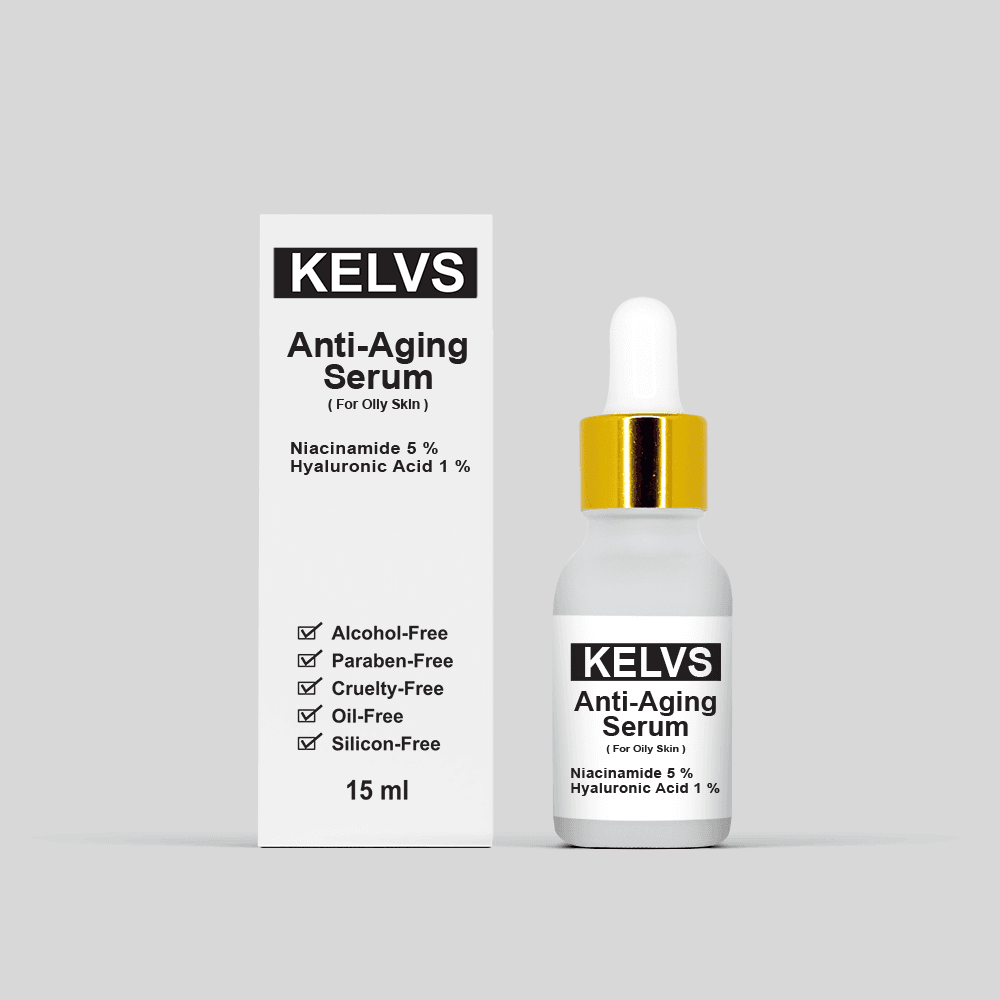 Official
KELVS Anti Aging Serum | Minimizes Pores & Controls Oil
Scientifically formulated for maximum efficacy with zero harsh irritants. Restores skin balance, clears pores, and accelerates visible recovery.