Niacinamide Benefits for Skin: What It Actually Does for Acne, Oil & Skin Barrier (Pakistan Guide)
Waleed
29 Apr 2026
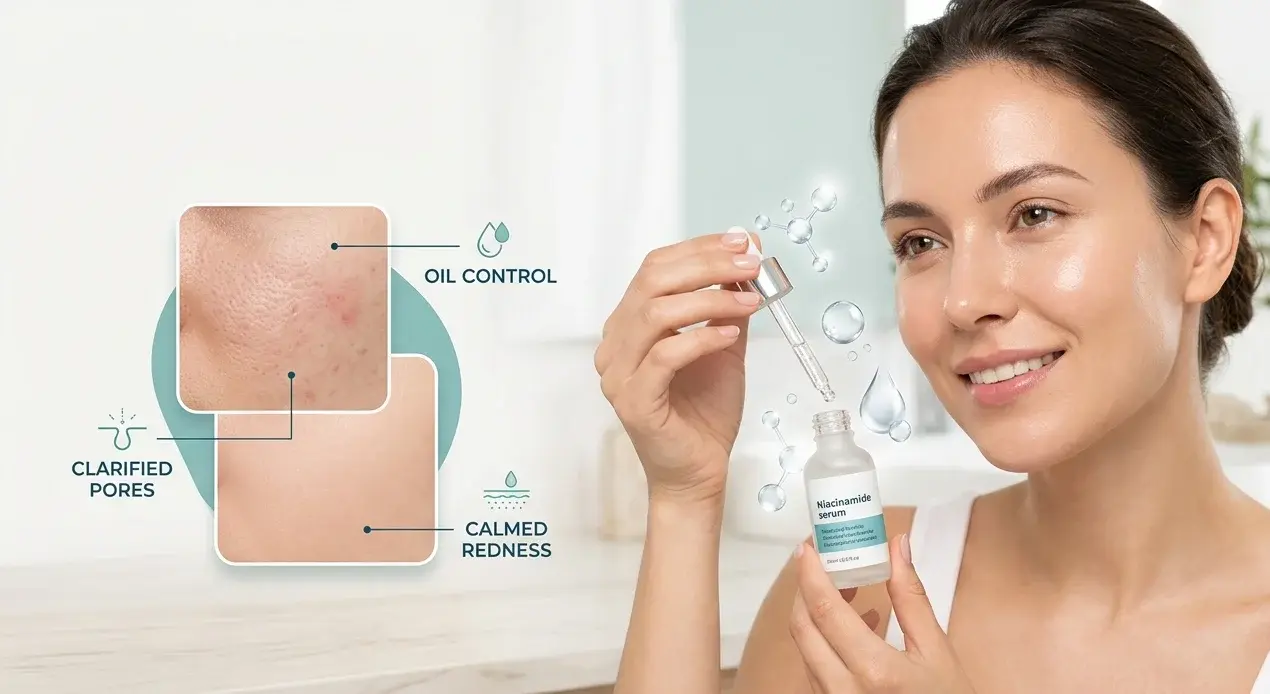
Niacinamide is a total multitasker for Pakistani skin. It regulates midday oil, calms angry acne, shrinks visible pores, and builds back the essential ceramides stripped away by harsh whitening creams. It’s the ultimate gentle balance for high humidity.
Introduction
Niacinamide has become one of the most searched skincare ingredients in Pakistan — and for good reason. It controls oil in the heat. It reduces acne without aggressive side effects. It repairs the skin barrier that so many people have unknowingly damaged through years of harsh whitening creams, exfoliating scrubs, and stripping cleansers. And it does all of this gently enough to be used every single day, on almost every skin type.
But for all the attention it receives, niacinamide is often described in vague terms — "brightening," "balancing," "good for everything" — without a clear explanation of what it is actually doing to the skin at a biological level. This guide cuts through the noise. It explains what niacinamide is, what it genuinely does for each skin concern, how to use it correctly in Pakistan's climate, and what realistic results look like over time.
What Is Niacinamide?
Niacinamide is the active cosmetic form of vitamin B3, a water-soluble vitamin that plays essential roles in skin cell energy metabolism and repair. Unlike many skincare actives that target a single biological mechanism, niacinamide works across several pathways simultaneously — which explains why a single ingredient can address acne, oiliness, sensitivity, and uneven tone at the same time.
It is water-soluble, stable across a wide temperature range, and well-tolerated by the large majority of skin types including sensitive, acne-prone, and barrier-damaged skin. These properties make it particularly practical for Pakistani users, where the climate stresses skin with heat, humidity, and UV — and where barrier-damaged skin from formula cream or steroid cream use is exceptionally common.
What Does Niacinamide Actually Do?
Three core mechanisms explain why niacinamide benefits so many different skin concerns at once.
It Regulates Sebum Production
Niacinamide inhibits the activity of sebaceous glands — the oil-producing structures beneath the skin surface — measurably reducing the rate of sebum secretion over consistent use. This directly reduces shine, decreases pore congestion, and lowers the substrate available for the bacteria that drive acne breakouts. Clinical studies using 4 to 5 percent niacinamide have demonstrated significant sebum reduction over eight to twelve weeks of daily use — without drying the skin in the process.
It Strengthens the Skin Barrier
Niacinamide stimulates the production of ceramides — the lipid molecules that form the structural mortar of the skin barrier. More ceramides mean a stronger barrier that retains moisture more effectively and resists penetration by irritants, pollutants, and bacteria. This makes niacinamide directly therapeutic for barrier-damaged skin and preventively valuable for keeping healthy skin resilient under environmental stress.
It Reduces Skin Inflammation
Niacinamide modulates pro-inflammatory signalling pathways in the skin, reducing the production of the cytokines that drive redness, swelling, and the post-acne inflammatory response. This anti-inflammatory action is one of the reasons niacinamide works across such a wide range of skin concerns — inflammation is a common driver behind acne, sensitivity, barrier damage, and post-inflammatory pigmentation alike.
Top Benefits of Niacinamide for Skin
Niacinamide for Acne
For acne-prone skin, niacinamide addresses the condition from multiple directions at once — which is why it produces more comprehensive improvement than single-mechanism acne treatments at equivalent concentrations.
Its sebum-reducing action decreases the oil that makes pores hospitable to acne-causing bacteria. Its anti-inflammatory action reduces the severity of active lesions and the post-acne response that creates dark marks. Its barrier-repairing action reduces the barrier compromise that makes skin more susceptible to breakout triggers. And its melanin transfer inhibition gradually fades the dark marks that remain after acne heals.
At 4 to 5 percent, niacinamide has been compared favourably to topical antibiotic treatments for mild to moderate acne in clinical studies — without the photosensitisation, dryness, or antibiotic resistance concerns. For Pakistani users dealing with heat-aggravated, humidity-driven breakouts, this combination of benefits in a single lightweight serum is particularly well-suited to the climate.
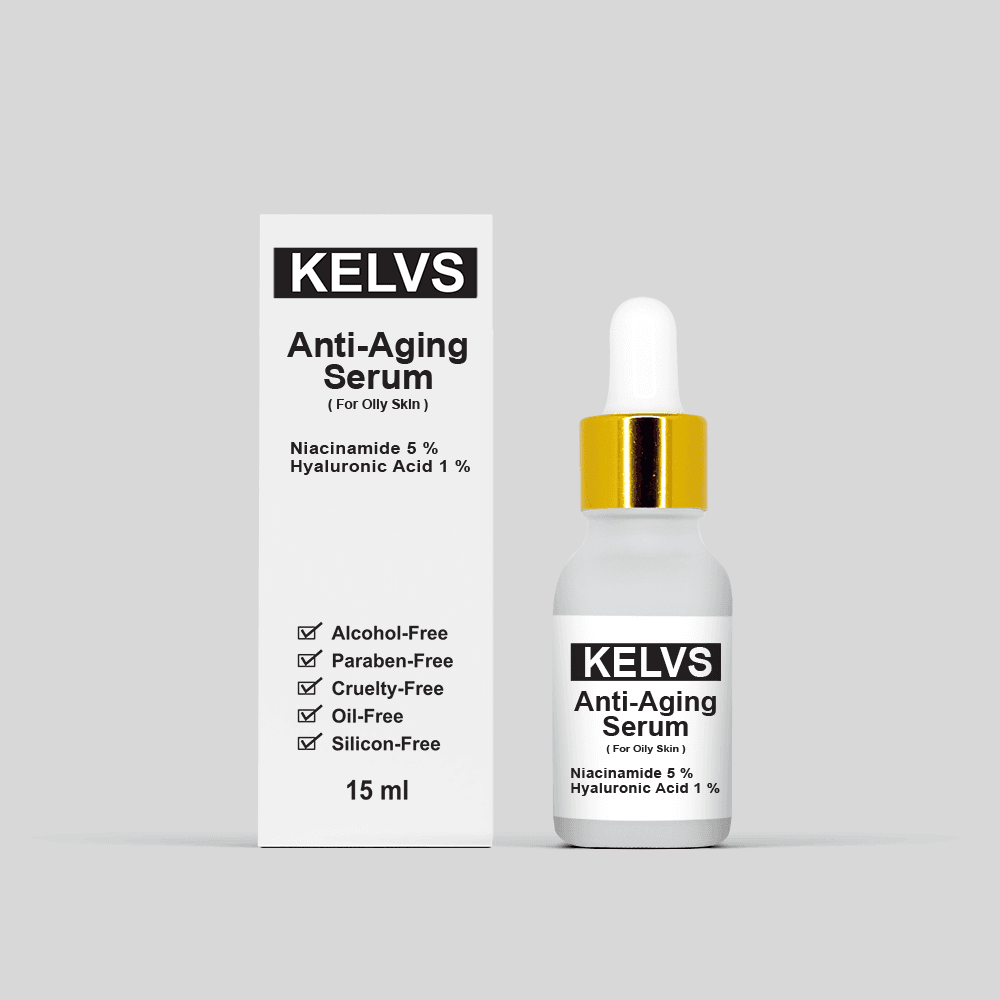
KELVS Niacinamide Serum is formulated at an effective concentration in a lightweight, water-based, fragrance-free base — designed for twice-daily use on acne-prone and oily skin in Pakistan's climate. Apply after cleansing, before moisturiser, morning and evening.
Niacinamide for Oily Skin
Oily skin in Pakistan is often more complex than it appears. A significant proportion of persistently oily skin is driven by a dehydrated or compromised barrier — the skin overproduces oil to compensate for moisture loss. Conventional Pakistani approaches to oiliness — astringent toners, alcohol-based products, frequent cleansing — address the symptom without the cause, and often worsen it by stripping the barrier further.
Niacinamide corrects this cycle at both ends: it reduces oil production directly while simultaneously strengthening the barrier, which reduces the dehydration signal that was driving excess sebum in the first place. Over eight to twelve weeks of consistent use, oily skin becomes measurably less shiny, pores appear less congested, and the oiliness does not rebound after the product is used — because the underlying cause, not just the surface effect, has been addressed.
According to the American Academy of Dermatology, non-stripping ingredients that regulate sebum production without disrupting the barrier are the recommended approach for managing oily skin — a description that matches niacinamide precisely.
Niacinamide for Large Pores
Pore size is largely determined by genetics — pores do not permanently enlarge or shrink regardless of which products are applied. What does change is how visible pores appear. When pores are congested with sebum, and when the surrounding skin is dehydrated and lacking elasticity, they look significantly larger than when they are clear and the skin around them is smooth and plumped.
Niacinamide improves pore appearance through two mechanisms simultaneously: reducing the sebum that fills and stretches pores, and improving the texture and elasticity of the surrounding skin through barrier support and ceramide stimulation. Most users notice a visible reduction in pore appearance between weeks six and ten of consistent twice-daily use, particularly on the nose, cheeks, and chin where sebaceous gland density is highest.
Niacinamide for Redness
Niacinamide's anti-inflammatory action makes it one of the most reliable non-prescription ingredients for calming persistent facial redness. Whether the redness is driven by acne inflammation, barrier compromise, reactive sensitivity, or the rebound flushing that follows discontinuation of steroid-containing whitening creams — niacinamide reduces the inflammatory signalling that underlies all of these presentations.
Some users with sensitive or reactive skin notice a reduction in redness within the first one to two weeks of use, as the anti-inflammatory effect establishes more quickly than the slower ceramide-building and sebum-modulation processes. This early calming is one of the clearest early signals that niacinamide is working — and for users who have been dealing with chronic redness from whitening cream damage, it is frequently the first noticeable improvement they experience.
Niacinamide for Skin Barrier Repair
The skin barrier is the foundation of all skin health. When it is compromised — by whitening creams, harsh cleansers, over-exfoliation, or climate stress — every other skin concern intensifies: acne worsens, sensitivity increases, pigmentation from inflammation becomes more pronounced, and even gentle products become irritating.
Niacinamide is one of the few cosmetic actives that actively repairs the barrier rather than simply avoiding further damage to it. By stimulating ceramide synthesis in the stratum corneum, it measurably restores the barrier's moisture retention capacity, reduces trans-epidermal water loss, and re-establishes the skin's tolerance for environmental stressors and topical actives. This is why niacinamide is recommended not just for skin that is currently experiencing barrier problems, but as a long-term maintenance ingredient for any skin that has been through a period of compromise.
According to DermNet's clinical overview of niacinamide, its ceramide-stimulating action is one of its most therapeutically valuable properties in dermatological practice — particularly for patients with compromised barrier function from any cause.
Building a barrier-safe routine? Read: Minimalist Skincare Routine for Sensitive Skin in Pakistan.
Who Should Use Niacinamide?
- Acne-prone skin — addresses sebum, inflammation, and barrier compromise simultaneously; safe during active breakout phases and for ongoing prevention between breakout cycles
- Oily skin types — the most reliable non-prescription sebum-reducing active that does not disrupt the barrier; particularly appropriate for Pakistan's heat and humidity
- Sensitive and reactive skin — anti-inflammatory action calms reactivity; barrier support reduces the frequency and intensity of reactive episodes over time
- Barrier-damaged skin — including those recovering from formula cream, steroid cream, or over-exfoliation damage; ceramide stimulation actively rebuilds what has been lost
- Anyone with post-acne marks — melanin transfer inhibition gradually fades existing PIH marks over eight to twelve weeks while ongoing oil and inflammation control prevents new ones forming
How to Use Niacinamide in a Routine
Niacinamide is a water-based serum applied after cleansing and before moisturiser. It integrates cleanly with almost all other skincare ingredients and does not require complex timing management beyond the standard layering principle of thinnest product first.
Layering order: cleanser — niacinamide serum — additional serums (e.g., alpha arbutin) — moisturiser — mineral sunscreen (morning only).
Morning routine:
- Gentle pH-balanced cleanser — lukewarm water; pat dry
- Niacinamide serum — 2 to 3 drops pressed into clean skin; allow 60 seconds to absorb
- Ceramide moisturiser — applied while skin is slightly damp
- Mineral sunscreen SPF 30 or above — final morning step; non-negotiable in Pakistan's UV environment
Evening routine:
- Double cleanse if wearing sunscreen — micellar water first, then gentle cleanser; single cleanse otherwise
- Niacinamide serum — 2 to 3 drops; 60 seconds absorption
- Ceramide moisturiser — slightly richer formula at night to support overnight barrier repair
Apply niacinamide by pressing it gently into the skin rather than rubbing — this avoids unnecessary friction on sensitised or acne-affected skin and does not drag the product across the face before it has absorbed.
How Long Niacinamide Takes to Work
| Timeframe | What to Expect |
|---|---|
| Weeks 1 to 2 | Skin feels calmer; redness may begin to reduce; oily skin may show early reduction in shine. No visible change in pore size or pigmentation at this stage. |
| Weeks 3 to 4 | Clearer reduction in shine and oiliness; fewer reactive flares on sensitive skin; early improvement in skin texture and smoothness. |
| Weeks 5 to 8 | Visible improvement in pore appearance; measurably fewer acne breakouts; skin tone begins to even; overall texture noticeably smoother. |
| Weeks 8 to 12 | Sustained oil control; visible fading of post-acne marks; barrier integrity demonstrably improved; skin handles environmental stress with noticeably less reactivity. |
Consistency is the primary determinant of how quickly results appear. Niacinamide's sebum-modulating and ceramide-building actions require a daily biological accumulation — missed applications extend the timeline proportionally. Twice daily, every day, is the commitment that produces the results documented in clinical evidence.
Common Mistakes When Using Niacinamide
- Using too high a concentration — above 10 percent, niacinamide can convert to nicotinic acid in the skin and cause transient flushing; the evidence-backed benefits for acne, oil control, and barrier repair are well-delivered at 4 to 5 percent; higher concentrations add risk without proportional reward
- Over-layering too many actives at once — introducing niacinamide alongside retinol, multiple exfoliants, and vitamin C simultaneously makes it impossible to identify the cause of any reaction; add niacinamide to a simplified routine and build from there
- Expecting instant results — the anti-inflammatory effect appears within one to two weeks; sebum reduction and barrier improvement require four to eight weeks; tone improvement requires eight to twelve; evaluating effectiveness at two weeks and concluding the product is not working is the most common reason for unnecessary discontinuation
- Inconsistent application — sporadic use does not produce sustained sebum modulation or ceramide accumulation; the clinical evidence for niacinamide's benefits is based on twice-daily use, consistently, over eight to twelve weeks; this is the non-negotiable commitment
Is Niacinamide Safe for Sensitive Skin?
Yes — and it is specifically recommended as a first active for sensitive or barrier-damaged skin by dermatologists, precisely because it supports the barrier rather than challenging it.
At 2 to 5 percent, niacinamide does not alter skin pH, does not exfoliate the barrier layer, and does not cause photosensitisation. Its anti-inflammatory action actively reduces the reactivity that defines sensitive skin — meaning the skin typically becomes more tolerant with continued use, not less. For users whose skin has been sensitised by whitening creams or over-exfoliation, niacinamide is often the first active that can be safely introduced once a minimal barrier repair routine has been established for four to six weeks.
The very small proportion of users who experience contact dermatitis from niacinamide should discontinue use. A patch test — applied to the inner forearm for five to seven days before full-face application — is a sensible precaution for anyone introducing a new active to a sensitive routine, though adverse reactions to niacinamide at 2 to 5 percent are genuinely uncommon.
Niacinamide and Pakistan's Climate
Pakistan's skincare environment creates specific pressures that niacinamide addresses particularly well. In the high-humidity heat of Karachi, Multan, and interior cities during summer, excess sebum contributes to congestion, acne, and the discomfort of wearing sunscreen on already-oily skin. Niacinamide's sebum control reduces all three problems without creating the dryness that makes sunscreen feel even more uncomfortable.
In dry Punjab winters and air-conditioned environments year-round, niacinamide's barrier-building action counters the dehydration that increases reactive skin events and makes post-acne pigmentation more persistent. Its thermal stability means it requires no special storage management in Pakistan's temperature extremes — unlike L-ascorbic acid vitamin C, which degrades in summer heat.
For the significant number of Pakistani users recovering from formula cream or steroid cream damage, niacinamide addresses the two most pressing concerns simultaneously: the barrier compromise caused by steroid use, and the rebound inflammation that produces the redness and new pigmentation that follow discontinuation. It is not a treatment for the damage itself — that requires a structured minimal routine — but it is one of the most practical ingredients to introduce once initial barrier stabilisation has been achieved.
Frequently Asked Questions
Can I use niacinamide every day?
Yes. Niacinamide at 2 to 5 percent is safe for twice-daily use in both morning and evening routines, indefinitely. It does not require periodic breaks, does not accumulate irritation with extended use, and does not create dependency or rebound effects after discontinuation. Consistent twice-daily use is in fact what the clinical evidence for its sebum-reducing and barrier-repairing effects is based on — this is the frequency that produces results.
What percentage of niacinamide is best?
For most skin concerns — acne, oil control, barrier repair, pore appearance, and tone improvement — 4 to 5 percent represents the optimal concentration. This is where the clinical evidence for niacinamide's benefits is strongest and most consistently replicated. For very sensitive or reactive skin being introduced to niacinamide for the first time, starting at 2 to 3 percent and stepping up to 4 to 5 percent after two weeks of confirmed tolerance is a sensible approach. Concentrations above 10 percent add flushing risk without proportional improvement for most skin types.
Does niacinamide actually help acne?
Yes — and through multiple mechanisms simultaneously. Niacinamide reduces the sebum that feeds acne-causing bacteria, lowers the inflammation that drives breakout severity, strengthens the barrier that acne disrupts, and fades the post-acne marks that acne leaves behind. At 4 to 5 percent, clinical studies have documented outcomes comparable to topical antibiotic treatments for mild to moderate acne — without the photosensitisation, dryness, or antibiotic resistance concerns. It is not a treatment for severe or cystic acne, which requires dermatological management.
Can I use niacinamide with vitamin C?
Yes. The concern that these two ingredients cannot be combined is outdated and based on a misreading of older chemistry research. In practice, at the concentrations and temperatures used in cosmetic formulations, the interaction between niacinamide and vitamin C is not clinically significant for the large majority of users. The most practical approach is to apply vitamin C first in the morning, allow 60 seconds for absorption, then apply niacinamide — or to use a stable vitamin C derivative such as ascorbyl glucoside or sodium ascorbyl phosphate rather than L-ascorbic acid, which requires a lower pH environment that is less compatible with niacinamide's neutral formulation.
Is niacinamide good for oily skin in Pakistan?
Yes — it is one of the most specifically appropriate ingredients for oily skin in Pakistan's climate. It reduces sebum production without drying or disrupting the barrier, which means it addresses oiliness at its source rather than temporarily masking it with astringents. In Pakistan's summer humidity, where excess sebum contributes to congestion, acne, and shine, twice-daily niacinamide use over four to eight weeks produces measurable and sustained oil reduction that improves skin comfort, appearance, and acne frequency simultaneously.
How long before niacinamide shows results?
Anti-inflammatory calming and early redness reduction can appear within the first one to two weeks. Visible improvement in oiliness and skin texture builds from weeks three to four. Pore appearance improvement and clearer acne reduction are typically evident by weeks five to eight. Post-acne mark fading and sustained overall tone improvement require eight to twelve weeks of consistent twice-daily use. Sunscreen applied every morning is essential throughout — without it, UV exposure continuously re-triggers the inflammation and pigmentation that niacinamide is working to reduce.
Conclusion
Niacinamide earns its reputation not through marketing but through mechanism. It reduces oil without stripping. It repairs the barrier without occluding. It calms acne without sensitising. It fades marks without the side effects that accompany stronger brightening agents. For Pakistani skin navigating heat, humidity, acne, and the long aftermath of harsh whitening cream use, very few single ingredients deliver as much genuine, evidence-backed benefit with as little risk.
Used twice daily at 4 to 5 percent, supported by a gentle cleanser, a ceramide moisturiser, and a mineral sunscreen, niacinamide is the kind of ingredient that quietly transforms skin over eight to twelve weeks — not dramatically, not overnight, but consistently and without compromise.
 Official
KELVS Anti Aging Serum | Minimizes Pores & Controls Oil
Scientifically formulated for maximum efficacy with zero harsh irritants. Restores skin balance, clears pores, and accelerates visible recovery.