Minimalist Skincare Routine for Sensitive Skin in Pakistan
Waleed
21 Mar 2026
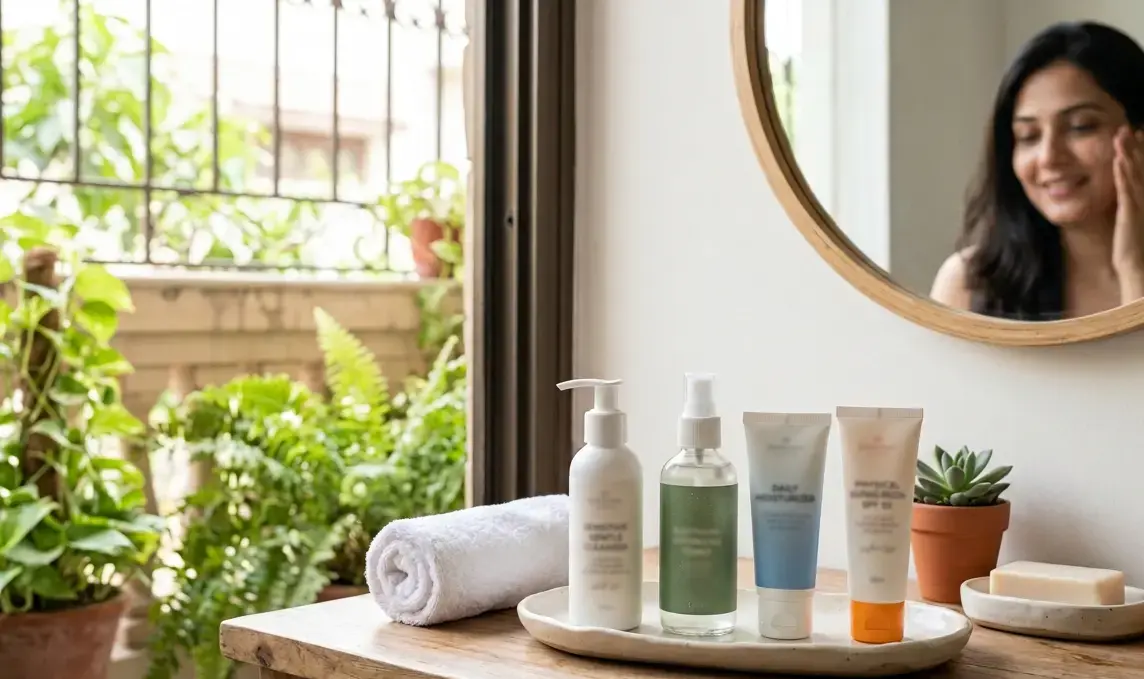
In Pakistan's climate, a heavy routine suffocates sensitive skin. Minimalism cuts the noise to save your barrier. All you need is a gentle cleanser, a soothing hydrator, and sun protection. Less friction means fewer breakouts and healthier skin.
Open any skincare influencer's page in Pakistan right now and you'll likely find a twelve-step routine — serums, essences, toners, exfoliants, masks, eye creams, facial oils — each product promising to solve a specific problem. The beauty industry has become extraordinarily good at making us feel that healthy skin requires constant intervention, and that more products equal more results.
For most people with sensitive skin, the opposite is true. The more you layer onto sensitised skin, the harder it has to work to cope — and the more likely you are to trigger redness, breakouts, and long-term barrier damage. A minimalist skincare routine is not a compromise or a budget shortcut. It is, in the opinion of most dermatologists, the single most effective approach available for reactive, sensitised, or easily irritated skin — particularly in a climate as demanding as Pakistan's.
This guide explains the science behind minimalist skincare, why overloading your skin with products backfires, and exactly how to build a simple morning and evening routine that genuinely works for sensitive skin in Pakistan.
What Is Minimalist Skincare — And Why Does It Work?
Minimalist skincare is exactly what it sounds like: a deliberate reduction of your routine to only the products your skin genuinely needs to be healthy. Typically, this means three core products — a gentle cleanser, a moisturiser, and a sunscreen. Occasionally a targeted treatment is added when a specific, well-defined concern warrants it. Nothing else.
The reason this approach is so effective for sensitive skin comes down to a fundamental principle of skin biology: your skin is not a passive surface to be corrected — it is an active, self-regulating organ. The outer layer, the skin barrier, continuously repairs itself, regulates moisture levels, manages its microbial ecosystem, and filters environmental threats. This system functions best when it is supported, not overridden.
Every product you apply to your face introduces a new set of variables — surfactants, preservatives, active ingredients, fragrances, emulsifiers — each of which the skin must process and respond to. For skin with a strong, intact barrier, this is manageable. For sensitive skin, where the barrier is already operating below its optimal threshold, each additional product represents an additional opportunity for irritation, inflammation, or a destabilising interaction with something else in the routine.
The American Academy of Dermatology consistently recommends that people with sensitive or reactive skin keep their routines as simple as possible, introduce new products one at a time, and prioritise barrier function over treating surface-level concerns — advice that aligns precisely with the minimalist philosophy.
→ Foundation Reading: How to Repair Your Skin Barrier After Whitening Cream Damage
How Overusing Skincare Products Damages Sensitive Skin
It might seem counterintuitive that doing more for your skin could leave it worse off — but for sensitive skin, product overload is one of the most common and most overlooked causes of chronic skin problems in Pakistan.
Too Many Actives Overwhelm the Barrier
Active ingredients — vitamin C, retinol, AHAs, BHAs, niacinamide, benzoyl peroxide — are potent by design. Each one alters how the skin behaves at a cellular level. Used correctly and individually, many of them are beneficial. Layered together on skin that is already reactive, they compete, interact unpredictably, and collectively exceed the barrier's tolerance threshold. The result is the exact opposite of what was intended: worsening sensitivity, redness, and breakouts.
Fragrance Accumulation Is a Hidden Trigger
In Pakistan, where skincare products are frequently chosen for their scent as much as their efficacy, fragrance is a significant contributor to sensitive skin reactions. A toner with fragrance, a serum with fragrance, a moisturiser with fragrance, and a sunscreen with fragrance together deliver a cumulative fragrance load that any sensitised skin will struggle to tolerate — even if no single product would cause a problem on its own. Fragrance is one of the most common contact allergens in skincare globally, and its effects are dose-dependent.
Over-Cleansing Strips the Barrier
The Pakistani habit of thorough, multiple-times-daily cleansing — driven by genuine environmental factors like heat, dust, and humidity — can significantly deplete the skin's natural lipid layer when harsh cleansers are involved. Every time you over-cleanse with a stripping product, you remove the ceramides and fatty acids that hold your skin barrier together. This leaves skin temporarily vulnerable, and in people who over-cleanse daily, the barrier never fully recovers between washes.
The "Fix It Fast" Cycle
When sensitive skin reacts to a product overload with redness or breakouts, the instinct is often to add something to fix the new problem. This creates a compounding cycle — a reaction leads to a new product, which leads to a new reaction, which leads to another product — until the skin is managing six or seven products at once and the original cause of the problem has been completely obscured. Minimalism breaks this cycle by removing variables rather than adding them.
→ Related: Side Effects of Formula Creams on the Face – Pakistan Skincare Guide
Why Minimalist Skincare Is Particularly Effective in Pakistan's Climate
Pakistan's environmental conditions make the case for minimalism even stronger than in more temperate climates. The country's skincare challenges are real and significant — and the best response to them is a resilient, well-maintained skin barrier, not a complex multi-product routine.
Heat and humidity in Karachi, Multan, Hyderabad, and coastal regions mean that heavy layering of multiple products traps sweat and sebum, increasing the risk of miliaria (heat rash), clogged pores, and fungal overgrowth on sensitised skin. A minimal routine lets skin breathe and thermoregulate more effectively.
Dust and urban pollution in Lahore, Peshawar, and Islamabad deposit particulate matter and oxidative stressors on the skin throughout the day. A solid, simple routine that includes a gentle cleanser and a barrier-reinforcing moisturiser handles this more reliably than a complex multi-step layering system that introduces its own chemical load.
Intense UV radiation — with Pakistan's UV index regularly reaching 10 to 12 in summer — means that daily mineral sunscreen is a non-negotiable component of any routine, and getting that one product right matters far more than debating whether to add a third serum.
Hard, mineral-rich water common across Punjab raises the effective pH of water used for washing — a factor that disrupts skin pH with every cleanse. A pH-balanced gentle cleanser used twice daily is the most direct way to counter this, and it is sufficient.
What to Look for — and What to Avoid — in Products for Sensitive Skin
| Ingredient / Feature | For Sensitive Skin | Why |
|---|---|---|
| Ceramides | ✓ Yes | Directly replenish the lipid matrix of the skin barrier; foundational for sensitive skin repair and maintenance |
| Panthenol (Provitamin B5) | ✓ Yes | Calms inflammation, accelerates barrier repair, and improves skin hydration without irritation |
| Hyaluronic Acid | ✓ Yes | Draws and retains water in the skin; hydrates without adding occlusive weight — ideal for Pakistan's heat |
| Niacinamide (2–5%) | ✓ Yes | Strengthens barrier function, regulates sebum, and reduces redness at low concentrations — safe for sensitive skin |
| Zinc Oxide (Mineral SPF) | ✓ Yes | Sits on top of skin, doesn't penetrate; mildly anti-inflammatory — the gold standard for UV protection on reactive skin |
| Synthetic Fragrance / Parfum | ✗ Avoid | Top contact allergen in skincare globally; cumulative exposure from multiple fragranced products triggers chronic sensitisation |
| Sulfates (SLS / SLES) | ✗ Avoid | Highly effective at stripping oils — including the ceramides your barrier needs; excessively harsh for daily use on sensitive skin |
| Denatured Alcohol | ✗ Avoid | Dissolves skin lipids on contact; causes immediate dehydration and long-term barrier depletion with repeated use |
| High-Strength AHAs / BHAs | ✗ Avoid | Over-exfoliates the barrier layer; appropriate for healthy skin used occasionally, not for daily use on sensitive or reactive skin |
| Essential Oils | ✗ Avoid | Marketed as "natural" but many (lavender, tea tree, citrus) are potent sensitisers on compromised skin |
The KELVS Minimalist Routine for Sensitive Skin in Pakistan
The following two-part routine — morning and evening — is built around the principles of barrier support, minimal ingredient load, and practical suitability for Pakistan's climate. Each step has a clear purpose; nothing is included for its own sake.
☀️ Morning Routine — 3 Steps
- Gentle Cleanse
Wash your face with lukewarm (never hot) water and a pH-balanced, sulfate-free, fragrance-free cleanser. This removes overnight sebum buildup and prepares skin for the products that follow without stripping your barrier's lipid layer. Pat — never rub — skin dry with a clean towel. - Ceramide Moisturiser
Apply your moisturiser immediately after cleansing while skin is still slightly damp. Look for ceramides, panthenol, and hyaluronic acid. In Karachi's humid summers, a lighter gel-cream formula is preferable; in dry Punjab winters or air-conditioned environments, a richer cream provides better occlusion. This step is non-negotiable even for oily-sensitive skin types — dehydrated skin overproduces sebum, worsening congestion. - Mineral Sunscreen SPF 30+
Apply a mineral sunscreen (zinc oxide or titanium dioxide base) as your final morning step. In Pakistan's UV environment, this is the single highest-impact skin health decision you make every day — bar none. Reapply every two hours during outdoor activities.
🌙 Evening Routine — 2 Steps
- Gentle Double Cleanse (if wearing sunscreen)
If you wore sunscreen during the day — which you should — begin with a fragrance-free micellar water or a balm cleanser to dissolve the sunscreen, followed by your gentle face cleanser. This ensures complete removal without requiring excessive rubbing on sensitised skin. If you did not wear sunscreen, a single gentle cleanse is sufficient. - Ceramide Moisturiser (slightly richer at night)
Your skin does most of its barrier repair work at night, when cell turnover is at its peak. Apply a ceramide moisturiser — using a slightly richer formula than your morning application if tolerated. This creates an optimal environment for overnight healing. No serums, no actives, no treatments during the barrier recovery or maintenance phase. Let your skin work.
Where KELVS Gentle Cleanser Fits In
The cleanser is the most foundational product in any minimalist routine — the step that sets the tone for everything that follows. A harsh cleanser undoes every other effort you make; a gentle one creates the conditions for the rest of the routine to succeed.
How to Transition to a Minimalist Routine
If you're currently using six or more products and your skin is reactive, the transition to a minimal routine requires a little patience — but it is simpler than it sounds.
Begin by identifying which products in your current routine contain fragrance, alcohol, or strong actives. Remove these first. Keep whichever gentle cleanser and moisturiser you currently use (or switch to better formulations), and keep your sunscreen. Cut everything else — toners, essences, serums, exfoliants, masks — for a minimum of four weeks.
Your skin may go through a brief adjustment period in the first one to two weeks: some initial dryness or mild breakouts are normal as your barrier recalibrates without the stimulation of multiple actives. Stay the course. Most people find that their skin settles into a noticeably calmer, more balanced state by week three or four — and that it stays there as long as the minimal routine continues.
According to the AAD's guidance on restoring skin barrier function, consistent use of a simple, gentle routine over time reliably outperforms complex multi-step approaches for sensitive and barrier-compromised skin. Simplicity is not a limitation — it is a strategy.
Frequently Asked Questions
Q1: Doesn't sensitive skin need more products to address all its problems?
This is one of the most common misconceptions in skincare. Sensitive skin does not have more problems — it has a lower tolerance threshold. The solution is not more targeted products but a more supportive environment for the skin barrier to function and self-regulate. A three-product routine that protects and reinforces the barrier will resolve more of sensitive skin's apparent "problems" than a ten-product routine that overwhelms it.
Q2: I have oily skin and I'm scared a minimalist routine will leave my skin looking greasy. What should I do?
Oily skin in Pakistan is frequently a sign of skin that is dehydrated — often by over-cleansing or harsh products — and compensating by overproducing sebum. A gentle cleanser that doesn't strip the skin, paired with a light gel-based ceramide moisturiser, typically reduces oiliness significantly within two to three weeks as the skin stops overcompensating. Look for moisturisers labelled "non-comedogenic" and "oil-free" to keep the texture comfortable in Pakistan's heat.
Q3: Can I follow a minimalist routine if I also have pigmentation or acne concerns?
Yes — and in fact, a minimalist routine is the ideal foundation before addressing pigmentation or acne with targeted treatments. Without a stable, functioning skin barrier, active ingredients for pigmentation or acne are more likely to cause irritation than results. Spend four to six weeks building and stabilising your barrier with a minimal routine first, then introduce a single targeted treatment — such as azelaic acid for both acne and pigmentation — under dermatological guidance.
Q4: How many products is "minimalist" — and is there a maximum?
There is no single definition, but most dermatologists working within the minimalist framework suggest a maximum of three to five products in a daily routine: cleanser, moisturiser, and sunscreen as the non-negotiables, with one or at most two targeted treatments added only when a stable baseline has been established. More than five products applied daily to sensitive skin significantly increases the risk of cumulative irritation and ingredient interactions.
Q5: Is KELVS Gentle Cleanser suitable for everyday use in Pakistan's hot, humid climate?
Yes — KELVS Gentle Cleanser is formulated for twice-daily use across all climate conditions, including the heat and humidity of Karachi and coastal regions as well as the dry winters of Lahore and Islamabad. Its sulfate-free, fragrance-free formula removes sweat, sebum, and daily impurities without over-stripping the skin — the most common problem with standard cleansers used in hot climates where people feel the need to wash their face more frequently.
Q6: Do I need to use a toner as part of a minimalist routine?
No. Toners are not a necessary step for most skin types, and for sensitive skin they introduce an additional product layer that often contains alcohol, fragrance, or astringent ingredients that worsen barrier function. If your concern is balancing skin pH after cleansing, a well-formulated pH-balanced gentle cleanser eliminates that need entirely. Skip the toner and apply your moisturiser directly after cleansing — your skin will not miss it.
The Simplest Truth in Skincare
The skincare industry profits from complexity. The more products it can convince you that you need, the more it sells. But your skin operates on entirely different principles — it thrives on consistency, gentleness, and the freedom to regulate itself without constant intervention.
For sensitive skin in Pakistan — navigating heat, UV, dust, pollution, hard water, and a market full of products making extravagant promises — the minimalist approach is not just a preference. It is the most evidence-backed, dermatologist-aligned strategy available. Three good products, used consistently, will always outperform twelve mediocre ones.
Start with a gentle cleanser. Build from there. Let your skin show you what it actually needs — which is almost certainly less than you think.
Disclaimer: This blog post is for educational purposes only and does not constitute medical advice. If you are experiencing persistent skin conditions or reactions, please consult a qualified dermatologist for personalised guidance.
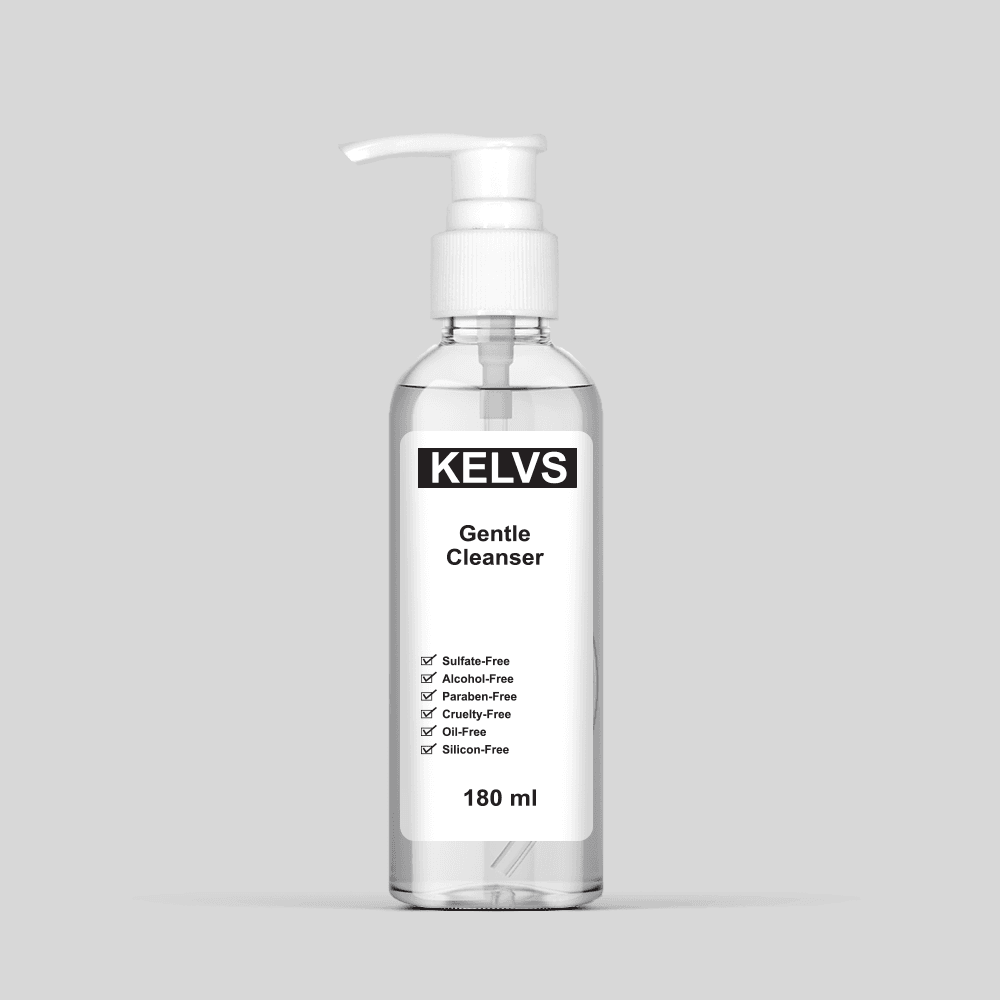 Official
KELVS Gentle Cleanser | Sulfate-Free Daily Cleanse
Scientifically formulated for maximum efficacy with zero harsh irritants. Restores skin balance, clears pores, and accelerates visible recovery.