Why Whitening Creams Damage Your Skin Barrier – Pakistan Skincare Guide
Whitening creams are one of the most widely used skincare products in Pakistan — but many of them contain ingredients that silently erode your skin's most vital defence: the skin barrier. This guide explains exactly why whitening creams damage the skin barrier, which harmful ingredients to look out for, and how to protect and rebuild your skin with a routine that actually works long term.
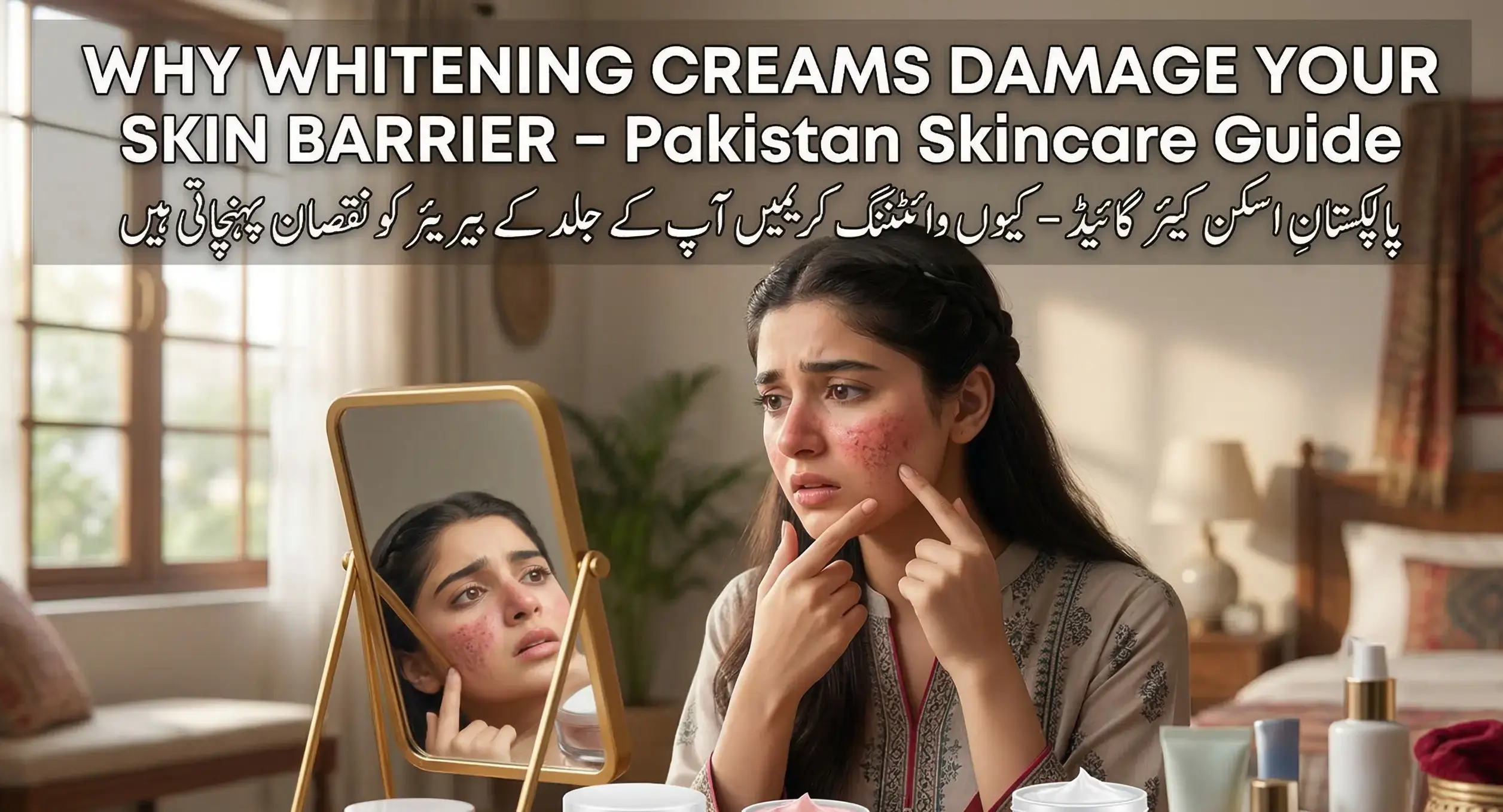
In Pakistan, whitening creams are not a niche product category — they are a skincare staple. From television commercials to pharmacy shelves to beauty parlours in every city and town, fairness and brightening creams are among the most heavily marketed and most frequently purchased skincare items in the country. And the appeal is entirely understandable: clear, even-toned skin is something almost everyone wants, and these products promise exactly that — quickly and affordably.
But behind the promise lies a problem that dermatologists across Pakistan have been raising concerns about for years. Many widely used whitening creams — particularly unregulated formula creams and some mass-market fairness products — contain ingredients that do not simply fail to deliver on their promises. They actively damage the skin's most fundamental protective system: the skin barrier.
This post is not about telling you what products to stop using. It's about giving you the information you deserve so that every decision you make about your skin is a truly informed one. Understanding why whitening creams damage your skin barrier is the first step to protecting yourself — and to eventually achieving the healthy, even-toned skin you're actually looking for.
First, What Exactly Is the Skin Barrier?
Before we can understand how whitening creams damage the skin barrier, we need to understand what the skin barrier actually is — because it is far more than just the outer surface of your skin.
The skin barrier, or stratum corneum, is the outermost layer of the epidermis. It consists of flattened, dead skin cells called corneocytes tightly packed together and embedded in a lipid matrix — a mixture of ceramides, cholesterol, and fatty acids that acts like mortar between bricks. This structure, sometimes called the "brick and mortar" model of the skin, performs several critical functions simultaneously:
When the barrier is healthy, skin looks calm, feels comfortable, and handles environmental stressors without reacting. When it is damaged — even mildly — the entire system begins to break down. Moisture escapes. Irritants penetrate. Inflammation becomes chronic. Skin that was once resilient becomes reactive to almost everything.
The American Academy of Dermatology identifies a compromised skin barrier as a root cause of many of the most common and frustrating skin concerns — including persistent dryness, redness, acne, and sensitivity — all of which are reported at high rates by Pakistani whitening cream users.
Why Are Whitening Creams So Widely Used in Pakistan?
Understanding the widespread use of whitening creams in Pakistan requires context, not judgement. The preference for lighter skin in South Asian culture is deeply rooted — shaped by decades of media representation, matrimonial expectations, professional perceptions, and a long history of colonial beauty standards that associated fairness with desirability and success. These pressures are real, pervasive, and felt by people of all genders, ages, and social backgrounds.
Add to this the fact that whitening creams in Pakistan are inexpensive, widely available, and deliver visible results remarkably fast — at least initially — and the pattern of widespread use becomes very easy to understand. What is harder to understand, without access to dermatological information, is why the skin that looked brighter and smoother in week two looks red, reactive, and patchy in month six.
The answer, almost always, lies in what those creams are actually doing beneath the surface.
The Harmful Ingredients in Whitening Creams — and How They Break Down the Barrier
Not every whitening cream is harmful, and not every brightening ingredient is dangerous. The problem lies in a specific cluster of ingredients — particularly those found in unregulated formula creams and some mass-market fairness products — that achieve short-term skin lightening through mechanisms that are fundamentally destructive to the skin barrier over time.
| Ingredient | How It "Works" on Skin | How It Damages the Barrier |
|---|---|---|
| Topical Steroids (betamethasone, clobetasol, fluocinolone) |
Suppresses inflammation, creating immediate appearance of brightness and smoothness | Depletes ceramide production, thins the lipid matrix, causes long-term barrier thinning and steroid dependency |
| High-Concentration Hydroquinone (above 2%, unregulated OTC use) |
Inhibits melanin synthesis to reduce pigmentation | Irritates and sensitises the barrier at high concentrations; long-term use linked to ochronosis (paradoxical darkening) and chronic inflammation |
| Mercury Compounds (ammoniated mercury, mercurous chloride) |
Blocks melanin production for rapid skin lightening | Directly toxic to epidermal cells; destroys the structural integrity of the barrier and accumulates systemically |
| High-Strength AHAs/BHAs (undisclosed glycolic, salicylic acid concentrations) |
Exfoliate surface cells rapidly for a "brighter" appearance | Over-exfoliation removes the corneocyte layer faster than it can regenerate, leaving skin without its first line of defence |
| Synthetic Fragrances & Parfum | Mask the chemical odour of active ingredients | One of the most common contact allergens in skincare; triggers allergic and irritant contact dermatitis, chronically destabilising the barrier |
| Alcohol (Denatured) | Provides a lightweight, fast-absorbing texture | Dissolves ceramides and skin lipids, causing immediate dehydration and long-term barrier depletion with repeated use |
The particular danger of formula creams in Pakistan is that many contain several of these ingredients simultaneously — and without disclosure. A consumer applying a formula cream daily may be unknowingly exposing their skin to a steroid, a bleaching agent, a high-strength exfoliant, and synthetic fragrance — all at once — without the knowledge or ability to mitigate the compounding damage.
→ Deep Dive: Side Effects of Formula Creams on the Face – Pakistan Skincare Guide
How Specifically Do These Ingredients Damage the Barrier?
The mechanism by which whitening cream ingredients break down the skin barrier can be understood in three interconnected stages — each building on and worsening the last.
Stage 1 — Lipid Depletion
The skin barrier's "mortar" is a precise blend of ceramides (roughly 50%), cholesterol (25%), and free fatty acids (15%). Topical steroids directly suppress ceramide synthesis, while denatured alcohol and strong surfactants dissolve existing lipids on contact. As the lipid matrix thins, the barrier becomes increasingly permeable — letting moisture out and irritants in. Skin begins to feel tight, dry, and uncomfortable despite appearing outwardly normal. This stage is largely invisible to the user, which is why damage is so often well-advanced before it is noticed.
Stage 2 — Inflammation and Sensitisation
As barrier permeability increases, environmental irritants — dust, pollution, bacteria, UV radiation — begin penetrating to the deeper layers of the epidermis where they trigger an immune response. The skin's inflammatory signalling system activates, producing redness, swelling, and heat. Simultaneously, the disrupted microbiome — now lacking the acidic, lipid-rich environment it needs — becomes imbalanced, allowing opportunistic bacteria and fungi to colonise. This is the stage at which most users first notice something is wrong: skin that used to be fine is now breaking out, flushing, or reacting to products it previously tolerated.
Stage 3 — Chronic Barrier Failure
With prolonged steroid or irritant exposure, the barrier's ability to self-repair is compromised. The skin enters a cycle of chronic inflammation in which every environmental trigger — sunlight, heat, sweat, water — produces a reaction. At this stage, users often feel that their skin has completely changed — as though it became "allergic" to everything at once. This is barrier failure, and it requires a deliberate, sustained repair strategy to reverse.
→ Is a Steroid Cream Involved? Read: Steroid Cream Damage on Face – Symptoms, Treatment & Recovery
Signs Your Skin Barrier Has Been Damaged by a Whitening Cream
These symptoms commonly appear in Pakistani patients with whitening-cream-related barrier damage. They may develop gradually over weeks or months, and not all signs will be present in every case:
- Persistent redness or flushing — skin that looks or feels hot, particularly on the cheeks and around the nose
- Burning or stinging — even from water, moisturiser, or gentle skincare products that previously caused no reaction
- Tightness and dehydration — skin that feels parched regardless of how much you moisturise
- New or worsening acne — particularly small, uniform breakouts around the mouth, chin, or cheeks
- Flaking or peeling — skin that sheds unevenly, especially after washing
- Heightened sensitivity to sunlight — unusual burning, darkening, or itching after even brief UV exposure
- Rebound darkening — skin that becomes noticeably darker after stopping the whitening product
- A feeling that skin has changed permanently — the sense that your skin is simply no longer the same as it was before
Pakistan's Climate Makes Barrier Damage Harder to Manage
Pakistan's environment creates additional challenges for anyone dealing with a compromised skin barrier — and understanding these challenges helps you build a more effective recovery strategy.
UV intensity is the most significant factor. Pakistan regularly records UV index values between 10 and 12 during summer months across Karachi, Lahore, Islamabad, and inland cities. Barrier-damaged skin has lost much of its natural UV-buffering capacity, making it far more vulnerable to UV-triggered inflammation and post-inflammatory hyperpigmentation — the very darkening that many whitening cream users are trying to prevent.
Heat and humidity in coastal and southern regions increase sweating, which further disrupts skin pH and creates an environment in which bacterial and fungal overgrowth on compromised skin is accelerated. In contrast, dry winters and air-conditioned interiors across Punjab and KPK strip residual moisture from a barrier that is already dehydrated — a combination that makes chronic tightness and flaking significantly worse from October through February.
Water quality is an often-overlooked factor: the high mineral content in water across much of Pakistan — particularly in Punjab — raises the effective pH of water used for face washing, which disrupts the skin's natural acid mantle and weakens barrier function with every cleanse.
How to Protect and Repair Your Skin Barrier
Barrier repair is not a single intervention — it is a sustained shift in how you treat your skin, day in and day out. The following approach is designed around the specific challenges of Pakistan's climate and the particular type of barrier damage caused by whitening creams.
Start With the Right Cleanser
The single most impactful product change you can make is switching to a cleanser that does not further strip or destabilise your already-compromised barrier. Most soap bars and foaming cleansers — even widely trusted ones — are too alkaline and too surfactant-heavy for barrier-damaged skin. What you need is a pH-balanced, sulfate-free, fragrance-free cleanser that removes impurities without disrupting your skin's lipid layer.
→ Full Recovery Protocol: How to Repair Your Skin Barrier After Whitening Cream Damage
Restore Barrier Lipids with Ceramide Moisturiser
Immediately after cleansing, apply a fragrance-free moisturiser rich in ceramides, cholesterol, and fatty acids — the three lipid classes that directly replenish your skin's damaged mortar layer. Formulas containing panthenol (provitamin B5) accelerate barrier repair, while hyaluronic acid draws water into the skin to address dehydration at the cellular level. Apply while skin is still slightly damp to improve absorption before water evaporates — particularly important in Pakistan's dry interiors and air-conditioned environments.
Mineral Sunscreen — Every Day, Without Exception
Given Pakistan's UV intensity, this step is not optional. Choose a mineral sunscreen with zinc oxide or titanium dioxide, SPF 30 or higher, and apply it every morning — including overcast days, indoor days near windows, and days when you're only going outside briefly. Zinc oxide has the added benefit of being mildly anti-inflammatory, which makes it particularly appropriate for reactive, barrier-damaged skin. Avoid chemical UV filters during recovery as they can penetrate a compromised barrier and trigger irritation.
Practise Radical Simplicity During the Repair Phase
A three-product routine — gentle cleanser, ceramide moisturiser, mineral sunscreen — is the entire routine during the barrier repair phase. Vitamin C, retinol, niacinamide above 5%, AHAs, BHAs, and any product labelled "brightening," "exfoliating," or "resurfacing" should be completely paused for a minimum of four to six weeks. The temptation to add products is understandable, but it is consistently one of the most common reasons barrier recovery stalls.
Frequently Asked Questions
Q1: Can a whitening cream damage my skin barrier even if I don't use it every day?
Yes — frequency matters less than ingredient potency. A whitening cream containing even a moderate-strength topical steroid or high-concentration bleaching agent can cause measurable barrier damage with as little as three to four applications per week over several weeks. There is no truly "safe" frequency for products containing undisclosed steroids or mercury on facial skin. The only safe approach is knowing exactly what is in the product you're using.
Q2: My skin looked better when I used the whitening cream. Why is it worse without it?
This is one of the clearest signs of steroid-induced dependency. The "improvement" produced by steroid-containing whitening creams is a suppression of your skin's natural inflammatory activity — not an actual improvement in skin health. When the steroid is removed, the suppressed inflammation rebounds, making skin appear worse than before. This rebound is temporary. With consistent barrier repair, your skin will stabilise at its true, healthy baseline — which will be better than the artificially suppressed state the cream was maintaining.
Q3: Are there any whitening or brightening ingredients that do NOT damage the skin barrier?
Yes — there are evidence-backed brightening ingredients that can be used safely once your barrier has recovered. These include niacinamide (at concentrations of 2–5%), tranexamic acid, azelaic acid, alpha-arbutin, and stable forms of vitamin C such as ascorbyl glucoside. The key distinctions from harmful whitening ingredients are: they do not contain steroids, they work through melanin regulation rather than inflammation suppression, and they are used at concentrations that are clinically studied and disclosed on the label. Always introduce new actives under dermatological guidance, one at a time.
Q4: How long does it take for the skin barrier to repair itself after whitening cream damage?
Recovery timelines vary significantly depending on the severity of damage and how long the harmful product was used. Mild damage — a few weeks of use with early-stage sensitivity — typically resolves within two to four weeks of a gentle routine. Moderate damage may take four to eight weeks. Severe barrier damage from months or years of steroid-containing cream use can take three to six months or longer, particularly when topical steroid withdrawal is involved. Consistency with a simple, gentle routine is the most important predictor of recovery speed.
Q5: Is KELVS Gentle Cleanser safe to use on skin that is currently burning or stinging?
KELVS Gentle Cleanser is formulated specifically to minimise the risk of stinging or irritation on sensitised skin — it contains no sulfates, synthetic fragrances, or known contact allergens. That said, if your skin is at the acute, severely inflamed stage of barrier damage or steroid withdrawal (oozing, intense burning, widespread rawness), it is advisable to consult a dermatologist before using any new products, including a gentle cleanser. For moderate sensitivity and the standard recovery phase, KELVS Gentle Cleanser is well suited to twice-daily use.
Q6: How can I tell if a whitening cream I'm currently using is damaging my barrier — before the damage becomes serious?
Early warning signs include: skin that feels tight or uncomfortable after washing (even when it looks fine), a slight increase in skin sensitivity to products you previously tolerated, new dryness or flakiness in areas that were not dry before, and a feeling that your skin "needs" the cream to look normal. If you notice any of these signs after starting a new whitening product, consider stopping it and introducing a minimal barrier-supportive routine. Early intervention dramatically shortens recovery time.
The Bottom Line
The desire for bright, even-toned skin is not the problem. The problem is a market environment in which some of the products sold to meet that desire contain ingredients that systematically dismantle the skin's most essential protective system — often without the knowledge of the people using them.
Your skin barrier is not a cosmetic feature. It is the foundation of every aspect of how your skin looks, feels, and functions. Protecting it is not a compromise on your skincare goals — it is the precondition for achieving them. Healthy, even-toned skin is only possible on a strong, well-functioning barrier. Everything else is a short-term illusion.
Start with the basics. Cleanse gently. Moisturise consistently. Protect from the sun every day. Give your skin the environment it needs to heal — and it will.
Disclaimer: This blog post is intended for educational purposes only and does not constitute medical advice. If you are experiencing severe skin reactions, signs of steroid dependence, or symptoms that do not improve with a gentle skincare routine, please consult a qualified dermatologist or physician.