How to Choose the Right Alpha Arbutin Serum — What Concentration Actually Works?
The alpha arbutin serum market is full of products claiming different concentrations — 1%, 2%, 5%, and beyond. But does a higher percentage actually produce better results? This guide explains the science behind effective alpha arbutin concentrations, which strength is appropriate for different skin concerns, how to identify a well-formulated product, and what to realistically expect from your routine in Pakistan's climate.
Introduction
Browsing for an alpha arbutin serum in Pakistan has become a more complicated task than it should be. Products come labelled at 1%, 2%, 3%, and 5% — sometimes combining alpha arbutin with other brightening actives at concentrations that are not always clearly disclosed. Faced with this range, the natural assumption is that a higher percentage delivers better or faster results. In skincare, however, this logic fails more often than it holds.
Alpha arbutin is one of the most dermatologist-recommended brightening ingredients available for independent cosmetic use — but its effectiveness is not simply a function of concentration. The relationship between percentage, efficacy, and safety is more nuanced than ingredient marketing typically suggests, and getting it wrong by using too high a concentration or a poorly formulated product can cause irritation that delays the very results you are trying to achieve.
This guide explains what alpha arbutin concentrations actually mean in terms of skin benefit and safety, which percentage is most appropriate for the most common pigmentation concerns in Pakistan, and how to identify a genuinely well-formulated product from the label alone.
Recommended Product : KELVS Whitening Serum
What Is Alpha Arbutin?
Alpha arbutin is a water-soluble glycoside derived from the bearberry plant. It functions as a tyrosinase inhibitor — it binds to the enzyme that initiates the melanin synthesis process, reducing the rate at which new pigment is produced in skin cells. As the skin's natural cell turnover cycle brings newer, less-pigmented cells to the surface over four to twelve weeks of consistent use, existing dark spots, post-acne marks, and areas of uneven tone gradually fade.
Dermatologists recommend alpha arbutin as an alternative to hydroquinone — the conventional gold-standard depigmenting agent — because it achieves similar melanin inhibition through a gentler, more controlled delivery mechanism. Because alpha arbutin releases its active component gradually and locally at the pigment cell level rather than flooding the skin with free hydroquinone, it does so without the significant irritation, photosensitisation, and ochronosis risk associated with hydroquinone at comparable depigmenting strengths.
At appropriate cosmetic concentrations, alpha arbutin is well-tolerated by most skin types including sensitive, acne-prone, and barrier-damaged skin — the three presentations most commonly seen in Pakistani users seeking brightening after whitening cream damage or acne recovery.
What Alpha Arbutin Concentrations Exist in Skincare Products?
Alpha arbutin is formulated across a range of concentrations in commercially available products. Understanding what each range typically means in practice helps set realistic expectations before purchase.
1% alpha arbutin — the entry-level cosmetic concentration. Effective for mild, recent pigmentation, daily maintenance of even skin tone, and as a first introduction for very sensitive or reactive skin. Lower concentration reduces the risk of any irritation during the early weeks of use. Results take longer to appear than at higher concentrations but are appropriate for consistent long-term maintenance use.
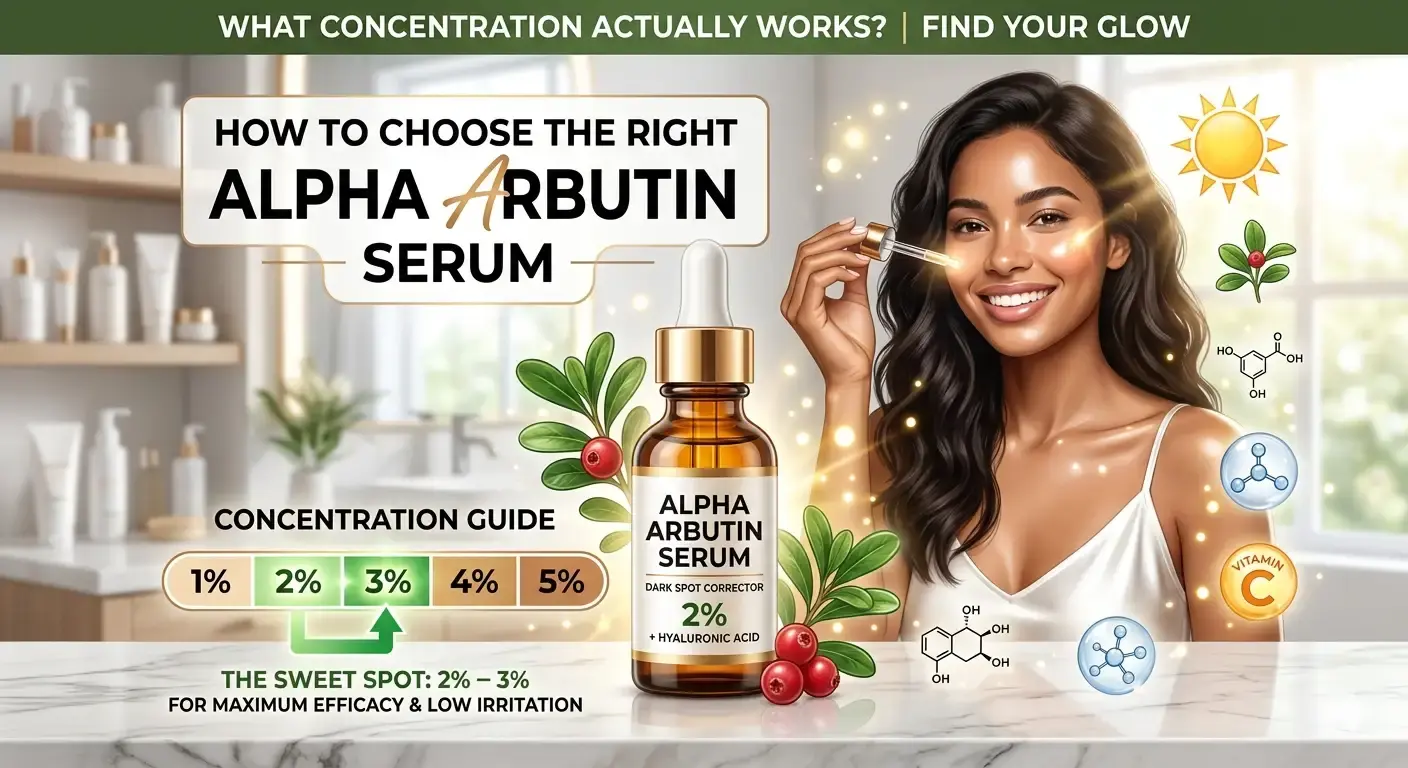
2% alpha arbutin — the most widely studied and clinically supported cosmetic concentration for brightening outcomes. At 2%, tyrosinase inhibition is effective across the main pigmentation presentations — post-acne marks, sun pigmentation, uneven tone, and melasma support routines — while remaining within a concentration range that is safe for most skin types without the need for the kind of careful frequency management required at higher percentages. This is considered by most dermatologists to be the optimal balance point between efficacy and safety for daily independent cosmetic use.
3% alpha arbutin — above the standard cosmetic range. Some products use 3% in combination with other brightening actives. At this concentration, the incremental brightening benefit over 2% is modest, while the cumulative irritation risk increases — particularly for users with sensitive or barrier-compromised skin. Products formulated at 3% may be appropriate for short-term targeted use on healthy, non-sensitive skin but are not the optimal choice for daily indefinite routine use.
5% alpha arbutin and combined brightening formulas — typically found in products that are combining alpha arbutin with other tyrosinase inhibitors or brightening actives. At 5%, alpha arbutin approaches concentrations where hydroquinone-equivalent activity becomes more significant — and where the irritation profile begins to resemble that of more aggressive depigmenting agents rather than the gentle cosmetic active that alpha arbutin is valued for being. Products at this concentration should be used with caution, are generally not appropriate for sensitive skin, and warrant a patch test and gradual introduction even on healthy skin types.
A note on stability: alpha arbutin in its purified alpha-isomer form is significantly more stable than beta arbutin — it resists degradation from heat, light, and pH fluctuation. However, even stable alpha arbutin degrades over time in improperly packaged products. Products stored in opaque or airless packaging preserve concentration and efficacy more reliably than those in open-top jars or clear bottles that expose the formula to repeated light and air contact. This consideration is particularly relevant in Pakistan's summer climate, where heat accelerates ingredient degradation.
What Is the Most Effective Alpha Arbutin Concentration?
The clinical consensus is clear: 2% alpha arbutin is the optimal effective concentration for cosmetic daily use. This is the concentration at which the balance between meaningful tyrosinase inhibition and a safe, well-tolerated daily application profile is most reliably achieved. The evidence supporting 2% alpha arbutin as effective for hyperpigmentation — including post-acne marks, sun pigmentation, and uneven tone — is more robust and more consistently replicated than the evidence for higher concentrations.
The assumption that higher concentrations produce proportionally better results does not hold for alpha arbutin for two reasons. First, tyrosinase inhibition by alpha arbutin follows a saturation curve — once tyrosinase binding sites are occupied at the level achieved by 2% application, additional alpha arbutin molecules do not produce a linearly greater effect. Second, the safety advantages of alpha arbutin over stronger depigmenting agents are partly dependent on its gradual, controlled delivery mechanism. At concentrations significantly above 2%, these safety advantages begin to narrow.
According to DermNet's clinical overview of depigmenting agents, alpha arbutin is preferred over hydroquinone for cosmetic daily use precisely because of its gentler delivery profile — a profile that is best preserved at the concentrations for which it was clinically evaluated, primarily 1 to 2 percent.
Alpha Arbutin 2% vs Higher Strength Serums
| Consideration | Alpha Arbutin 2% | Alpha Arbutin 3–5% (Higher Strength) |
|---|---|---|
| Effectiveness for Pigmentation | Well-established — clinically supported across all major PIH and pigmentation types | Marginally stronger on stubborn concentrated pigmentation; incremental benefit over 2% is modest for most users |
| Safety Profile | High — well-tolerated on most skin types including sensitive and barrier-compromised | Moderate — irritation risk increases; contact dermatitis more likely on sensitised skin |
| Daily-Use Suitability | Yes — appropriate for twice-daily indefinite use | Caution — daily use at 3–5% warrants monitoring; periodic cycling preferred over indefinite use |
| Sensitive Skin Suitability | Yes — including on skin recovering from barrier damage or whitening cream use | Not recommended — elevated irritation risk is poorly matched to compromised or reactive skin |
| Long-Term Use Suitability | Yes — no documented concerns with continuous long-term use at 2% | Better used in defined cycles rather than continuously without breaks |
| Melasma Support Routines | Appropriate as the primary daily brightening active in a sustained melasma maintenance routine | May be appropriate for short-term intensive use on stable, non-sensitive skin under dermatological guidance |
| Summer Suitability in Pakistan | High — no photosensitisation; stable in heat; safe for year-round daily use | Moderate — higher concentration increases cumulative irritation in high-UV conditions where skin is already stressed |
Does Higher Concentration Work Faster?
Not in any meaningful or reliable way for most users. This is the most common misconception about alpha arbutin concentration, and it is worth addressing directly because it drives purchasing decisions that often result in both wasted money and skin reactions.
The speed at which alpha arbutin produces visible results is determined primarily by three factors: the consistency of daily application, the quality of sun protection, and the skin's cell turnover cycle. None of these factors change with a higher serum concentration. A user applying 2% alpha arbutin twice daily with rigorous daily sunscreen will consistently outperform a user applying 5% alpha arbutin twice weekly without SPF — regardless of which product's label appears more impressive.
The cell turnover cycle — the time it takes for new skin cells to travel from the basal layer to the surface — is approximately 28 days in younger adults and lengthens with age. This biological timeline does not accelerate with higher concentrations of tyrosinase inhibitors. What changes with higher concentration is the degree of tyrosinase inhibition per application — but at 2%, inhibition is already substantial enough that the marginal gain from 5% does not translate to meaningfully faster surface results.
The practical consequence is straightforward: choose 2% applied consistently with sunscreen over a higher concentration applied inconsistently without it. The former will always produce better outcomes.
Which Alpha Arbutin Strength Is Best for Acne Marks?
For post-inflammatory hyperpigmentation from acne — the most prevalent pigmentation concern in Pakistan — 2% alpha arbutin is the appropriate and sufficient choice. There is no meaningful clinical evidence that higher concentrations produce better outcomes for PIH specifically, and the higher irritation risk at concentrations above 2% is particularly problematic for acne-prone skin.
Skin in active acne recovery is frequently sensitised, with a partially compromised barrier from prior breakouts, picking, or harsh product use. Applying a higher-concentration active to this already-stressed environment increases the risk of triggering new post-inflammatory responses that produce the very marks being treated. The 2% concentration delivers effective tyrosinase inhibition without adding further skin stress.
For users with acne marks who are also recovering from formula cream or steroid cream damage, 1% alpha arbutin introduced slowly during the early recovery phase — before stepping up to 2% once the skin has demonstrated full tolerance — is the most conservative and clinically appropriate approach.
Which Alpha Arbutin Strength Is Best for Melasma?
For melasma — hormonally triggered, UV-driven pigmentation requiring sustained long-term management — 2% alpha arbutin is the most appropriate concentration for daily independent cosmetic use. Melasma is a condition that requires continuous management over months and years rather than intensive treatment over short periods. This sustained requirement makes daily-use safety the more important criterion than peak strength.
Higher-concentration alpha arbutin formulas do not meaningfully outperform 2% in melasma management when used as part of a sustained routine, and their higher irritation profile makes them less suitable for the continuous long-term application that melasma demands. Additionally, skin with melasma is frequently sensitive and photoreactive — characteristics that align poorly with the higher irritation risk of 3 to 5% concentrations.
For moderate to severe melasma, a dermatologist-guided approach incorporating prescription-strength depigmenting agents alongside 2% alpha arbutin and strict daily mineral sunscreen will produce better outcomes than independently attempting higher-concentration brightening. Alpha arbutin at 2% is most valuable in a melasma routine as the gentle, consistent daily-use ingredient that reduces new pigment production between professional treatments or alongside prescription actives.
Which Alpha Arbutin Strength Is Best for Sensitive Skin?
For sensitive, reactive, or barrier-compromised skin, 1% alpha arbutin is the most appropriate starting concentration, with transition to 2% once skin tolerance is established over two to four weeks of use without any adverse reaction.
The safety advantages of alpha arbutin over other depigmenting agents — the characteristics that make it suitable for sensitive skin in the first place — are most fully expressed at 1 to 2% concentrations. Below this range, efficacy becomes insufficient for visible brightening. Above it, the gentle delivery profile that defines alpha arbutin's value for sensitive skin begins to narrow. 2% is the ceiling for sensitive skin independent cosmetic use; concentrations above this are not appropriate for skin types that are reactive, recovering, or barrier-compromised.
Supporting the barrier alongside alpha arbutin use is equally important for sensitive skin. A ceramide-rich moisturiser applied after the serum provides the lipid replenishment that supports barrier integrity and reduces any residual risk of irritation — not because 2% alpha arbutin is irritating in itself, but because strong barrier function universally improves the skin's tolerance of any topical active.
According to the American Academy of Dermatology's guidance on skin barrier restoration, maintaining barrier integrity through ceramide replenishment is a foundational requirement for tolerating topical active ingredients on sensitive or reactive skin — and should be prioritised before and alongside any brightening intervention.
How to Identify a Good Alpha Arbutin Serum
The product label and ingredient list reveal more about a serum's real-world effectiveness than any marketing claim. Here is what to look for and what to avoid when evaluating an alpha arbutin serum for purchase in Pakistan.
Concentration transparency — a well-formulated product states its alpha arbutin concentration clearly on the packaging or product listing. Products that do not disclose the percentage, or that list alpha arbutin far down in the ingredient list (indicating a very low, potentially sub-effective concentration), are not reliable choices. The concentration should be stated as a percentage and should be between 1% and 2% for routine cosmetic use.
Formula simplicity — a good alpha arbutin serum does not need a long ingredient list. The most effective formulations pair alpha arbutin with complementary hydrating and barrier-supporting actives — hyaluronic acid for hydration, niacinamide for barrier reinforcement and complementary brightening, and panthenol (provitamin B5) for soothing — without layering in additional high-potency actives that increase the aggregate irritation risk.
Absence of unnecessary harsh actives — a well-designed alpha arbutin serum should not include high-concentration AHAs, retinol, or benzoyl peroxide in the same formula. Including these alongside alpha arbutin creates an unnecessarily high combined active load for a daily-use product. If a formula contains alpha arbutin alongside multiple other strong actives, it is better suited to infrequent targeted use than daily application.
Stable, protective packaging — alpha arbutin in its purified form is stable, but formulas with multiple active ingredients degrade more quickly in light and air exposure. Opaque bottles, pump dispensers, or airless packaging preserve formula integrity significantly better than open jars or clear glass bottles. In Pakistan's summer temperatures, this matters more than in temperate climates.
Absence of synthetic fragrance — fragrance in skincare is the most common contact allergen and a significant contributor to sensitisation in users with acne-prone or reactive skin. A well-formulated brightening serum has no need for fragrance — its presence signals a formulation priority mismatch.
KELVS Alpha Arbutin Serum is formulated at 2% alpha arbutin in a lightweight, fragrance-free base that pairs the active with hyaluronic acid for simultaneous hydration. The formula discloses its concentration, contains no unnecessary harsh actives, and is packaged to preserve stability — meeting the criteria above for a transparent, well-designed daily-use brightening serum appropriate for Pakistan's climate and the skin concerns most common in Pakistani users.
For context on what to avoid in brightening products: Side Effects of Formula Creams on the Face.
Ingredients That Work Well With Alpha Arbutin
The following ingredients are compatible with alpha arbutin, enhance its overall performance in a routine, and can be safely used alongside it in the same session or in alternating steps:
- Niacinamide (2–5%) — inhibits melanosome transfer, complementing alpha arbutin's melanin production inhibition; also provides barrier support, oil regulation, and anti-inflammatory action; apply niacinamide first, then alpha arbutin
- Hyaluronic acid — draws water into the skin for hydration; no brightening interaction but improves overall skin comfort and absorption of subsequent layers; can be paired in the same serum or applied as a separate layer
- Panthenol (provitamin B5) — calms inflammation, accelerates barrier repair, and improves hydration retention; a particularly valuable pairing for sensitised or acne-recovering skin using alpha arbutin
- Ceramide moisturiser — applied after serums to reinforce the lipid matrix of the skin barrier; improves overall tolerance of active ingredients including alpha arbutin
- Mineral sunscreen (zinc oxide or titanium dioxide base) — the most important accompanying product in any alpha arbutin routine; without daily SPF 30 or above in Pakistan's UV environment, the brightening progress of alpha arbutin is continuously countered by melanin re-stimulation from UV exposure
Ingredients to Avoid Mixing With Strong Alpha Arbutin Formulas
- High-concentration AHAs and BHAs — glycolic acid above 5%, lactic acid above 8%, and salicylic acid above 2% used in the same routine as alpha arbutin at 2% or above significantly increases the cumulative active load; over-exfoliation on top of tyrosinase inhibition disrupts the barrier regeneration that is essential for the cell turnover cycle through which alpha arbutin's results accumulate
- Retinol or retinoids — retinol accelerates cell turnover, which can theoretically complement depigmenting action; however, on sensitive or barrier-damaged skin, the combination of retinol irritation and the active load of an alpha arbutin routine frequently produces adverse reactions; if both are used, separate them into different routine sessions — retinol on alternate evenings; alpha arbutin every morning and evening
- Formula creams and unregulated whitening creams — the most important avoidance for Pakistani users; steroid-containing formula creams used alongside an alpha arbutin serum create an unpredictable and potentially harmful combined active load; the barrier damage caused by formula creams also counteracts the cell turnover-dependent mechanism through which alpha arbutin works
- Multiple brightening serums simultaneously — alpha arbutin does not need to be combined with kojic acid, tranexamic acid, azelaic acid, and vitamin C in the same routine step to be effective; combining multiple brightening actives at the same time adds unnecessary complexity and irritation risk without producing meaningfully better results than two well-chosen, compatible ingredients used consistently
How to Use Alpha Arbutin Serum Correctly
The correct application of alpha arbutin follows the standard layering principle for water-based actives: applied to clean, dry or barely-damp skin after cleansing, before any cream or oil-based products, and before sunscreen in the morning.
Full routine incorporating alpha arbutin:
- Gentle cleanser — pH-balanced, sulfate-free, fragrance-free; lukewarm water; pat dry; this step is the foundation — a stripping or high-pH cleanser undermines barrier function and reduces the effective absorption of everything applied after it
- Niacinamide serum (if using) — applied first if using both; allow 60 seconds to absorb
- Alpha arbutin serum — 2 to 3 drops applied to clean skin; press gently; allow 60 seconds for full absorption before the next step; do not rub into skin — pressing is gentler and does not drag sensitised or acne-recovering skin
- Ceramide moisturiser — applied while skin is still slightly damp to lock in hydration; the most important post-serum step for barrier support
- Mineral sunscreen SPF 30 or above (morning only) — applied as the final morning step; in Pakistan's UV environment, this is the step that determines whether the alpha arbutin routine produces results or marks time
Morning and Evening Routine Examples
Morning routine:
- Gentle pH-balanced cleanser — lukewarm water; pat dry
- Niacinamide serum (optional but complementary) — 60 seconds absorption
- Alpha arbutin serum 2% — 2 to 3 drops; press into skin; 60 seconds absorption
- Lightweight ceramide moisturiser — applied while skin is slightly damp
- Mineral sunscreen SPF 30 or above — final step; reapply every two hours during sustained outdoor exposure
Evening routine:
- Double cleanse if wearing sunscreen — gentle cleansing oil or micellar water, followed by gentle face cleanser; single gentle cleanse if no sunscreen was worn
- Niacinamide serum (optional) — 60 seconds absorption
- Alpha arbutin serum 2% — 2 to 3 drops on clean skin; 60 seconds absorption
- Ceramide moisturiser — slightly richer formula at night to support overnight barrier repair and cell renewal
Evening application of alpha arbutin is valuable because skin undergoes peak cell turnover and repair activity overnight. Applying alpha arbutin before the overnight repair window ensures the ingredient is active during the period of highest cellular responsiveness.
How Long Does Alpha Arbutin Take to Work?
Weeks 1 to 2: No visible surface change in most users. Alpha arbutin is inhibiting tyrosinase at the cellular level before surface changes are expressed. Skin may feel more hydrated if the serum contains hyaluronic acid. This stage requires patience — abandoning the routine here means investing in a process that never had time to produce output.
Weeks 3 to 4: Early improvement visible in mild, recent pigmentation and acne marks as the first cell turnover cycle completes. Skin tone may appear marginally more even. Users with moderate or deep marks will not yet see substantial change.
Weeks 5 to 8: The primary result window. Existing marks are visibly lighter; areas of uneven tone appear more uniform; new marks from recent acne are not deepening. This is the stage at which most users confirm that the routine is working and commit to continuing.
Beyond 8 weeks: Cumulative improvement continues. Moderate marks are substantially faded. Deep or long-standing pigmentation continues to improve gradually but may require 12 to 24 weeks of consistent use for complete resolution. Ongoing use maintains results and prevents new marks from forming or deepening.
The effectiveness of this timeline is directly dependent on daily mineral sunscreen use. In Pakistan's summer months particularly, each day of unprotected UV exposure at a PIH site re-stimulates melanin production at a rate that can negate a week's worth of alpha arbutin progress. Sunscreen is not supplementary to this routine — it is half of it.
Common Mistakes When Choosing and Using Alpha Arbutin Serums
- Choosing the highest available percentage automatically — the most common mistake; 5% does not perform better than 2% for most users and carries a higher irritation risk that increases the likelihood of discontinuing the routine before results appear
- Buying a product with an undisclosed concentration — if a product does not state its alpha arbutin percentage, the concentration may be too low to be effective (common in products that use alpha arbutin as a label claim rather than an active); always verify the percentage before purchasing
- Mixing too many actives in the same routine — adding kojic acid, high-concentration vitamin C, AHAs, and retinol to a routine that already contains 2% alpha arbutin creates a combined active load that frequently triggers the irritation and barrier disruption that makes brightening harder, not easier
- Skipping sunscreen — the most consequential error in any alpha arbutin routine; Pakistan's UV environment counteracts the melanin inhibition of alpha arbutin every unprotected day; no concentration of serum overcomes the continuous re-stimulation of daily unprotected sun exposure
- Expecting overnight results and discontinuing early — alpha arbutin requires a minimum of six to eight weeks for visible improvement to appear; users who evaluate results at two weeks and find none are abandoning the routine before it has had time to produce output
- Purchasing unstable formulas in improper packaging — clear glass dropper bottles and open jars expose the formula to light and air that degrades active ingredients; in Pakistan's summer heat, this degradation happens faster than in temperate climates; choose opaque or airless packaging
Best Choice for Pakistani Skin Types and Climate
The specific conditions of Pakistan's climate and skincare market create several considerations that are directly relevant to choosing an alpha arbutin serum concentration.
Summer heat and stability: Pakistan's summer temperatures — reaching 45°C or above in interior cities — accelerate ingredient degradation in improperly packaged products. At 2%, a well-packaged, stable alpha arbutin formula retains efficacy across these temperatures. At 5%, the formula's stability depends not just on the alpha arbutin itself but on the stability of all the other actives typically combined in higher-concentration products, which is more difficult to maintain consistently.
UV intensity and photosensitisation: Alpha arbutin at any concentration does not cause photosensitisation — it does not increase the skin's sensitivity to UV radiation. This is one of its clearest advantages over stronger depigmenting agents in Pakistan's high-UV environment. This advantage applies equally at 2% as at higher concentrations — it is a property of the ingredient, not the concentration.
Formula cream recovery users: For users whose skin has been damaged by steroid-containing whitening creams and is simultaneously dealing with barrier compromise and rebound pigmentation, 1% alpha arbutin is the appropriate starting concentration after the barrier has been stabilised on a minimal repair routine. This population — which is substantial in Pakistan — should not start with 2% or above until the skin has demonstrated stability and tolerance over several weeks.
Urban pollution: In Pakistan's more polluted cities, the daily oxidative stress from environmental particulate matter adds to the skin's overall burden. Keeping the alpha arbutin routine simple — a well-formulated 2% serum rather than a complex high-concentration multi-active formula — reduces the product variable in reactions, making it easier to maintain the routine consistently and identify the cause if any reaction occurs.
Frequently Asked Questions
Is 2% alpha arbutin enough for pigmentation?
Yes. For the large majority of pigmentation concerns managed independently — post-acne marks, sun-related dark spots, uneven tone, and melasma support routines — 2% alpha arbutin provides effective tyrosinase inhibition for visible improvement over six to twelve weeks of consistent daily use. The clinical evidence supporting 2% as an effective cosmetic concentration is well-established. Higher concentrations do not consistently produce better outcomes for these presentations and carry a greater risk of irritation that increases the likelihood of routine discontinuation before results appear.
Does higher percentage work faster?
Not in any reliably meaningful way. The speed of visible results from alpha arbutin depends primarily on the consistency of daily application, the quality of sun protection, and the skin's cell turnover cycle — none of which change with a higher serum concentration. A user applying 2% twice daily with rigorous daily sunscreen will produce better visible results than a user applying 5% sporadically without SPF. Choose consistency over concentration.
Can alpha arbutin be used daily?
Yes. Alpha arbutin at 1 to 2% is safe for twice-daily use in both morning and evening routines without the need for periodic breaks or frequency management. This is one of its key advantages over stronger depigmenting agents — it can function as a continuous daily active without accumulating irritation, photosensitisation, or the dependency concerns associated with steroid-based brightening products. Consistent daily application is, in fact, a requirement for visible results — intermittent use does not produce meaningful pigmentation improvement.
Is alpha arbutin safe for sensitive skin?
Yes, particularly at 1 to 2% concentrations. Alpha arbutin does not alter skin pH, does not exfoliate, and does not cause the stinging or contact dermatitis associated with stronger depigmenting agents. It is appropriate for daily use on reactive, acne-prone, and barrier-compromised skin. For those recovering from whitening cream damage, introduce at 1% once the barrier is stable, and transition to 2% after two to four weeks of confirmed tolerance. Support with a ceramide moisturiser after every application to maximise barrier comfort.
Can alpha arbutin be used with niacinamide?
Yes — and this is one of the most frequently recommended pairings for brightening routines on sensitive and acne-prone skin. Alpha arbutin reduces melanin production; niacinamide reduces melanin transfer to the skin surface. Together they target two separate steps in the pigmentation pathway and produce better cumulative brightening than either alone. Apply niacinamide first, allow 60 seconds to absorb, then apply alpha arbutin. There are no documented incompatibility or interaction concerns between these two ingredients at standard cosmetic concentrations.
Which alpha arbutin serum is best for summer in Pakistan?
The ideal summer formulation for Pakistani conditions combines 2% alpha arbutin in a lightweight, water-based, fragrance-free formula, packaged in opaque or airless packaging to resist heat-related degradation. The formula should be free from photosensitising additives and strong exfoliants that increase UV vulnerability in Pakistan's high-UV summer climate. Crucially, any alpha arbutin serum used in Pakistani summer must be paired with mineral sunscreen SPF 30 or above applied every morning — without this step, summer UV exposure continuously re-triggers the melanin production that alpha arbutin is working to reduce. A serum alone, regardless of quality or concentration, cannot overcome daily unprotected UV exposure in Pakistan's summer conditions.
Conclusion
The question of which alpha arbutin concentration works best resolves clearly when examined through the evidence: 2% is the optimal effective concentration for cosmetic daily use across the most common pigmentation concerns in Pakistan. Higher concentrations do not produce proportionally better results for most users and bring increased irritation risk that frequently disrupts the consistent routine upon which all of alpha arbutin's results depend.
Choosing the right serum means reading the label for disclosed concentration, evaluating the supporting ingredients for barrier compatibility, checking for transparent packaging, and confirming the absence of fragrance and unnecessary high-potency additives. A simple, well-formulated 2% product used twice daily with rigorous daily sunscreen will consistently outperform a higher-concentration product used erratically without UV protection.
The brightening goal is achievable. The routine is straightforward. The most important variable in determining the outcome is not the number on the bottle — it is the consistency with which the bottle is used.